Factual Information
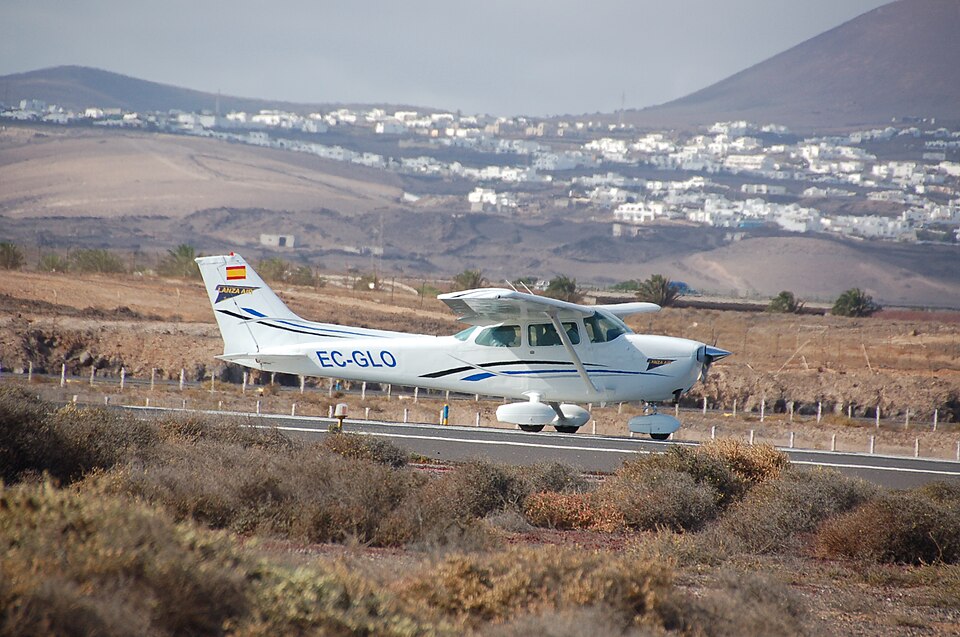
On 25 May 2024, at approximately 13:58 local time, a Cessna 172N aircraft, registration EC-GLO, operated by Airpilot Escuela de Vuelo, S.L. (d/b/a FLYSCHOOL), was involved in a bird strike incident. The flight was a training mission with dual controls, carrying a flight instructor and a student pilot. The aircraft had departed from Valladolid Airport (LEVD) at 12:45 local time, en route to Cuatro Vientos Airport (LECU) in Madrid.
Sequence of Events
The flight was initially planned as an instrument flight but was changed to visual flight rules (VFR) due to delays from previous legs. After refueling with 70 liters at Valladolid, the crew canceled the IFR plan and proceeded visually. They climbed to 7,500 ft and then descended to 4,500 ft to comply with terminal area altitudes. Near the Valmayor Reservoir, they observed a small raptor passing to their right and discussed recent bird strike incidents.
Shortly afterward, while at approximately 22 km northwest of Cuatro Vientos, near the municipality of Villanueva del Pardillo, a large bird struck the leading edge of the left wing. At that moment, the aircraft was descending from 4,000 ft toward the entry point of the Cuatro Vientos traffic circuit. The instructor, who was looking out the right window, heard the student say "pájaro" (bird) and then heard the impact.
The strike affected the aircraft's maneuverability. The instructor assumed control, declared an emergency, and requested landing on runway 27 at Cuatro Vientos. Air traffic control authorized the approach, and the landing was completed without further incident.
Aircraft and Crew
The aircraft was a Cessna 172N, registration EC-GLO. Both occupants were uninjured. The aircraft sustained minor damage. The instructor held a commercial pilot license (CPL(A)) and a flight instructor (FI) rating; the student was working toward a private pilot license (PPL(A)).
Meteorological Conditions
According to the instructor, the flight encountered crosswind and some tailwind, with significant turbulence throughout the flight, particularly over the Valmayor Reservoir and the Villanueva del Pardillo area.
Investigation Findings
The investigation concluded that the incident was caused by the impact with a large bird. A contributing factor was that the crew's visual lookout was not optimal for VFR flight, as the instructor was looking to the right and the student was focused on instruments.