History of the Flight
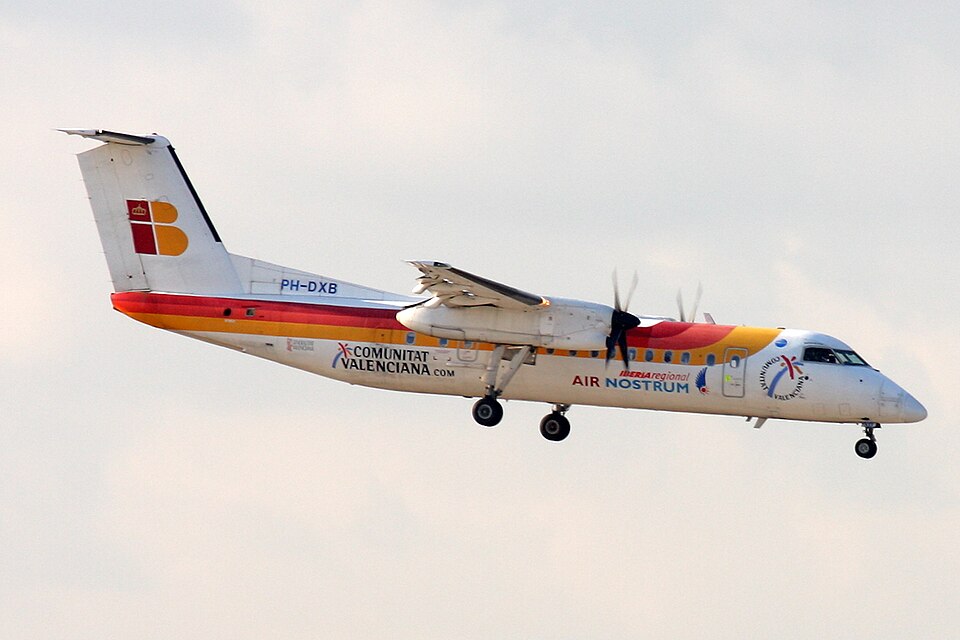
On 22 October 2009 at 10:50 UTC, a De Havilland DHC-8-315 with registration PH-DXB departed from Barcelona Airport on a scheduled passenger flight to San Sebastian. The aircraft was operated by Denim Air on behalf of Air Nostrum, with two pilots, one flight attendant, and 32 passengers on board. Weather conditions were adverse, with storm cells and heavy rain in the vicinity, causing traffic delays.
The flight began taxi at 10:15 UTC, 10 minutes late, with sufficient fuel for the round trip. The captain was the pilot flying. Takeoff from runway 25L was normal at 10:27. About three minutes later, the crew observed all three gear-not-locked red lights illuminated. They asked the flight attendant to visually check the main landing gear, who confirmed both main legs were down.
The aircraft was climbing through 7500 ft at 199 KIAS when the crew decided to return to Barcelona to address the gear issue using alternate or emergency extension procedures. ATC was notified and the aircraft was sequenced for landing.
During the alternate gear extension, the crew noted the Landing Gear Alternate Release Door was open. They closed it, hearing loud noises, then reopened it. They continued the alternate procedure, placing the selector lever to gear down, but were interrupted by joining the circuit on short final.
Before landing, the crew saw two green lights for main gear, one red light for nose gear, and three amber door-open lights. On short final, assuming the nose gear was not down, they declared an emergency and requested fire services. The flight attendant informed passengers. The aircraft landed on runway 25R at 10:48 after a 21:26-minute flight. Main gear was down and locked, nose gear was up, flaps at 15°, and the gear-down warning horn sounded continuously. Several GPWS warnings occurred. All three leg doors were open.
During landing on the wet runway, the nose contacted the asphalt for about 12 seconds until the aircraft stopped, damaging the two nose gear doors. Passengers evacuated under crew instructions, with some reluctance to leave baggage and to go into the rain. Fire services assisted.
Approximately an hour after evacuation, the front of the aircraft was lifted with a crane. Once lifted, the alternate nose gear control in the cockpit was actuated, and the nose gear lowered and locked correctly. The inhibit switch was found actuated, the overhead and floor doors were open, and the PTU selector was in manual.
Personnel Information
The captain, 38, held an ATPL(A) issued in 2000, with 6,300 total flight hours (5,000 on type). The first officer, 34, held an ATPL(A) issued in 2009, with 2,060 total hours (1,300 on type). Both had valid medical certificates and recent checks. The flight attendant had been on duty from 04:45.
Aircraft Information
The DHC-8-315 (serial 589) had a maximum takeoff weight of 19,495 kg and was powered by two Pratt & Whitney PW123E engines. At the time of the incident, it had 14,150 flight hours and 16,943 cycles. All scheduled maintenance was current; the last major overhaul was in July 2007. Two deferred items existed: replacement of the FMS unit and #1 audio panel.
Weight and balance were within limits. The calculated Vref with 15° flaps was 105 kt.
Landing Gear System
The retractable tricycle gear is powered by the No. 2 hydraulic system. Normal operation uses a selector lever and indicator lights: nine lights in three rows (amber for doors, green for down and locked, red for unlocked). The incident aircraft had all three amber lights illuminated after landing, indicating doors open.