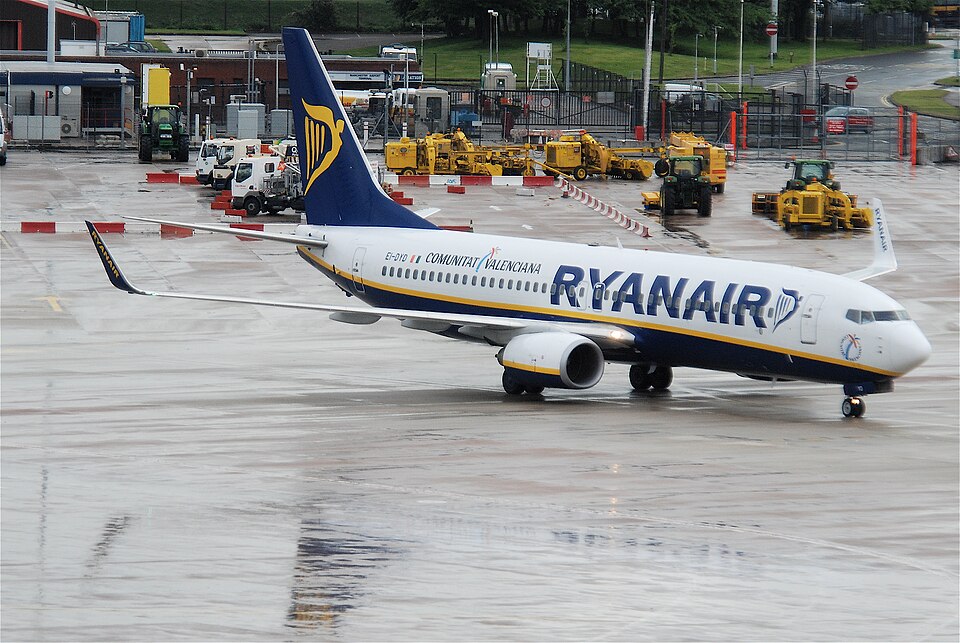
On October 21, 2024, a BOEING B737-800 (registration EI-DYD) was involved in an aviation accident near Aeropuerto de Tenerife-Norte (Santa Cruz de Tenerife), ES. Investigators recorded the probable cause as: A late takeoff clearance was issued while another aircraft was on short final and had also been cleared to land, without sufficient minimum space between the two aircraft. This summary draws on records from the Spanish Civil Aviation Accident and Incident Investigation Commission (CIAIAC).
On 21 October 2024, a Boeing 737-8AS (EI-DYD) and an Embraer ERJ 190-400 (EC-OEA) lost separation at Tenerife North. The 737 aborted its landing after being cleared to land while the ERJ was rotating.
Incident Overview On 21 October 2024, a separation incident occurred at Tenerife North Airport (GCXO) involving a Boeing 737-8AS, registration EI-DYD, and an Embraer ERJ 190-400, registration EC-OEA. The Boeing 737-8AS, operating as RYR5LW, was on final approach to runway 30 from Madrid Barajas. The Embraer ERJ 190-400, operating as IBB900Z, was taking off from the same runway. ## Sequence of Events The 737-8AS crew was cleared to land at the same time the ERJ 190-400 was rotating during its takeoff. The 737-8AS crew then decided to abort the landing and initiated a go-around. This resulted in a loss of separation between the two aircraft. ## Aftermath and Investigation Following the go-around, the 737-8AS was instructed to increase its climb rate, completed a circuit north of the runway, and landed normally. The ERJ 190-400 continued its takeoff and proceeded to Madrid Barajas, where it landed on schedule. The investigation determined that the loss of separation was caused by a late takeoff clearance issued while another aircraft was on short final and had also been cleared to land, without sufficient minimum space between them. A contributing factor was that the instructor controller took time to realize that the trainee controller was not managing the situation with sufficient effectiveness.
Probable cause
A late takeoff clearance was issued while another aircraft was on short final and had also been cleared to land, without sufficient minimum space between the two aircraft.
An X-AIR HAWK ultralight crashed in Chonburi, Thailand, killing the pilot and injuring a passenger. The accident was caused by deteriorated wing fabric and…
A Challenger II Special ultralight aircraft (U-B23) landed off-runway at Pai Airport, Mae Hong Son, on September 17, 2024, due to a gust of wind. No injuries…
The Polish aviation safety authority is investigating a serious incident involving an AT-3R100 aircraft that occurred on September 2, 2024. The investigation…
A SZD-48-3 glider suffered damage when its left wing struck a ground obstacle during a low final approach at EPWK on June 20, 2025. The pilot was uninjured.
A 39-year-old skydiver died after a hard landing near Leszno on May 1, 2026. The PKBWL preliminary report indicates the fatal impact resulted from a late,…
A student pilot crashed an SZD-50-3 Puchacz glider into the airfield fence during a solo training flight on June 6, 2026. The pilot was uninjured, but the…