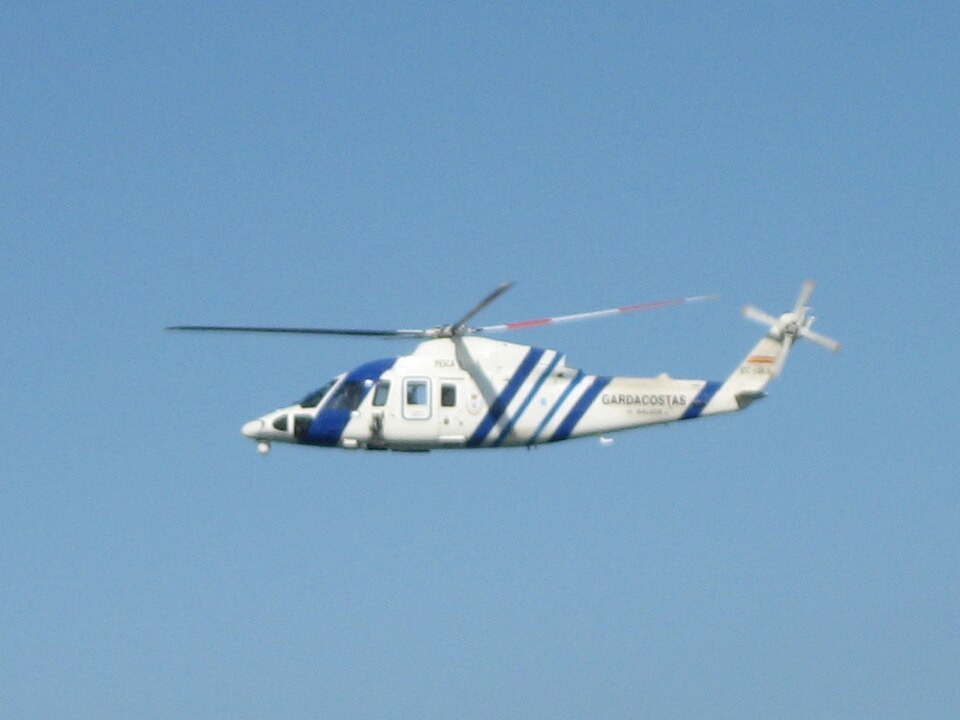
Sikorsky S-76 C+ nears sea surface during night training exercise

Casualties unknown • Ría de Vigo (Pontevedra), ES

A crew performing a night-time search and rescue training exercise inadvertently descended to within 22 feet of the sea level over the Vigo estuary.

What happened

On 26 July 2019, a Sikorsky S-76 C+ helicopter, registration EC-JES, was conducting a night-time search and rescue (SAR) training exercise over the Vigo estuary in Spain. The flight crew, which included a pilot, co-pilot, rescue swimmer, winch operator, and instructor, was simulating a cliff rescue maneuver.

During the approach, the crew intended to descend from a cruising altitude of 1,900 feet to a target altitude of 500 feet. While the crew believed they had engaged the appropriate altitude control modes, the aircraft continued a rapid descent. The crew only realized the danger when the rescue swimmer and winch operator noticed the proximity to the water and a sailing boat in the estuary. The aircraft's altitude dropped to just 22 feet above sea level before the co-pilot executed an emergency climb. There were no fatalities and no injuries to the five occupants, and the aircraft sustained no damage.

The investigation

The CIAIAC investigation examined the flight data recorder (FDR) and cockpit voice recorder (CVR) to reconstruct the descent. The investigation established that while the autopilot was coupled and the vertical speed mode was active, the altitude preselect (ALT PRE) function had not been correctly activated.

Investigators also reviewed the cockpit environment, noting that the crew was managing multiple simultaneous tasks, including communications with maritime rescue and air traffic control. The investigation found significant confusion regarding cockpit alarms; the crew reported hearing various warnings, but there were discrepancies in which alarms were actually triggered and whether they were properly monitored or reset.

Findings

  • The primary cause of the incident was a loss of situational awareness by the flight crew.
  • The crew operated under the false assumption that the aircraft was maintaining a programmed altitude, when in fact the altitude control system had not been fully engaged.
  • A lack of altitude cross-checking and the absence of verbal call-outs during the descent prevented the crew from detecting the deviation.
  • The crew was distracted by a high workload, including communications and the coordination of the training exercise.
  • The co-pilot had limited experience with this specific aircraft type.

Safety action

  • The CIAIAC issued a recommendation to the operator, Babcock, to improve training regarding procedural adherence, response to cockpit warnings and alarms, and specifically to enhance CFIT (Controlled Flight Into Terrain) prevention during crew training exercises.

Probable cause

The incident was caused by the crew's loss of situational awareness, stemming from the incorrect assumption that the aircraft's altitude-hold mode was active, leading to a failure to monitor the descent.

Frequently asked questions

What happened in the 2019-07-26 aircraft accident near Ría de Vigo (Pontevedra), ES?

A crew performing a night-time search and rescue training exercise inadvertently descended to within 22 feet of the sea level over the Vigo estuary.

What aircraft was involved and where did it happen?

The accident on 2019-07-26 involved a aircraft, registration EC-JES, at Ría de Vigo (Pontevedra), ES.

What was the probable cause of the accident?

The incident was caused by the crew's loss of situational awareness, stemming from the incorrect assumption that the aircraft's altitude-hold mode was active, leading to a failure to monitor the descent.

Loading the flight search…