What happened
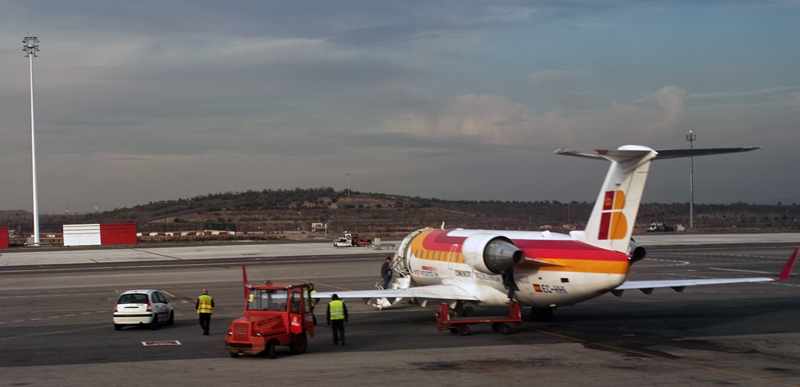
On October 21, 2000, an Air Nostrum Bombardier, Canadair CL-600-2B19 (registration EC-HHI) departed Valencia Airport to perform a functional flight test of the Air Driven Generator (ADG). The flight was intended to verify the emergency electrical power system as part of a scheduled maintenance requirement. The crew, consisting of a pilot, co-pilot, and a maintenance technician, followed a work card to deploy the ADG and monitor the electrical bus responses.
During the flight test, the crew observed warnings indicating that both Anti-Skid systems were inoperative. Consequently, the commander selected the Anti-Skid systems to the OFF position. The aircraft proceeded to land on runway 30 at Valencia Airport with the Anti-Skid systems intentionally deactivated.
During the landing roll, all four main gear tires burst. The aircraft subsequently slid across the asphalt, eventually coming to a stop approximately 2,000 meters from the runway threshold, oriented 40 degrees to the right of the runway centerline. The incident caused significant damage to the main gear wheels and brake assemblies, and the runway was closed for approximately two and a half hours to facilitate repairs.
The investigation
The CIAIAC examined the flight data recorder (FDR) and the aircraft's maintenance history. The investigation revealed that the Anti-Skid warnings were a byproduct of the electrical configuration changes required for the ADG test, rather than an actual system failure. The investigation also noted that the crew's approach speed was initially high at 280 kt before stabilizing at 150 kt.
Investigators found that the landing distance required for the aircraft at its weight of 18,200 kg with inoperative Anti-Skid systems and a 20-degree flap configuration was estimated at 2,800 meters, which exceeded the available 2,700 meters of runway 30. While the aircraft landed with 45-degree flaps, the lack of Anti-Skid functionality led to a loss of lateral control and wheel locking, which contributed to the tire bursts.
Findings
- The immediate cause of the incident was the landing with the Anti-Skid system disconnected, which is a high-risk operation.
- The crew failed to properly evaluate the status of the Anti-Skid system, assuming the warnings indicated a real failure without verifying the impact of the ongoing electrical tests.
- The flight test preparation was insufficient; the company's procedures for special test flights lacked specific protocols for crew briefing, task assignment, and post-flight debriefing.
- The work card used for the test did not warn that the electrical configuration changes during the ADG test could trigger spurious Anti-Skid warnings.
Safety action
- It is recommended that Air Nostrum establish formal procedures for the preparation of flight tests, including specific protocols for crew designation, task execution, and result documentation.
- Procedures should ensure that at least one pilot has direct experience in executing the specific flight test being performed.
- It is recommended that Air Nostrum include decision-making and situational re-evaluation training in its pilot training programs to better manage abnormal and emergency situations.