Flight History
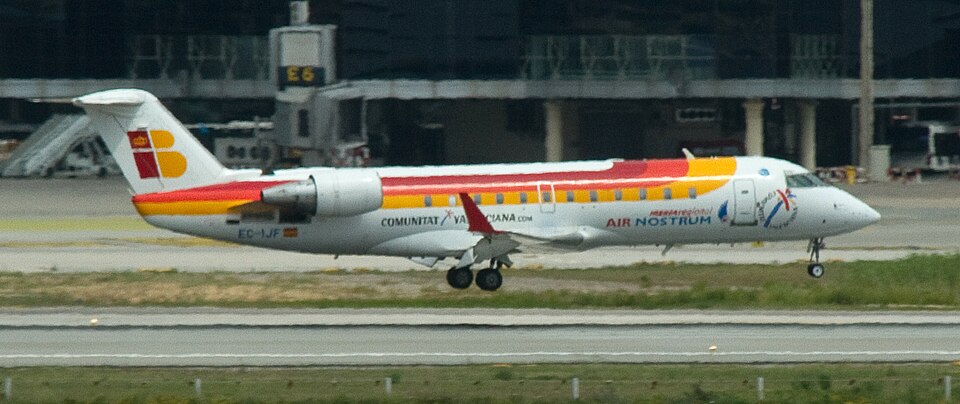
On 27 July 2006, at 22:01:22 local time, Air Nostrum flight AN8174, a Bombardier CRJ200 (registration EC-IJF), departed Barcelona Airport runway 25R on a scheduled passenger service to Basel, Switzerland. The cockpit crew comprised a 36-year-old captain and a 29-year-old copilot, with two cabin crew attending 44 passengers. Six minutes after departure, air traffic control cleared the aircraft to deviate from the standard instrument departure to avoid a storm area.
At 22:15:43, while climbing through 23,515 feet at 248 knots and heading 060°, approximately 29.8 nautical miles east of Barcelona, a loud bang occurred followed by strong jolts. Immediately, warnings activated for left engine reverser unlock, lavatory smoke, left engine low oil pressure, and, seven seconds after the bang, left engine fire. The crew executed the engine fire procedure: the engine was shut down 16 seconds after the fire warning, and the first fire extinguisher bottle was discharged 71 seconds later. The fire warning persisted, prompting discharge of the second bottle. The crew declared an emergency and decided to return to Barcelona.
While flying toward the airport on a heading of 250°, the crew performed a 360° turn to lose altitude and begin the final approach. The cabin crew prepared passengers for an emergency landing with possible evacuation. At 22:25:30, during short final and after 9 minutes and 40 seconds, the left engine fire warning cleared. The aircraft landed safely on runway 25R with one engine and stopped on exit taxiway GA at 22:29:27. The crew ordered an evacuation via the right side using the front and rear doors. Firefighting services applied foam as a precaution, though no flames or smoke were observed. All 48 people onboard were uninjured.
Damage to Aircraft
Damage was confined to the left engine. A fan blade had detached, along with the upper and lower access cowls, and areas showed evidence of intense fire burn-through. No damage occurred to the rest of the aircraft.
Personnel Information
The captain held an airline transport pilot license, with 5,100 total flight hours, including 3,950 on the CRJ. He had flown 3 hours 20 minutes in the 24 hours prior. The copilot held a commercial pilot license, with 1,714 hours, all on the CRJ. Both held valid ratings and had recent cockpit resource management training. The cabin crew had valid licenses; the purser had 1,536 hours and the second attendant 91 hours at the company.
Aircraft Information
The Bombardier CRJ200 (serial number 7705) was manufactured in 2002 and delivered to Air Nostrum in November 2002. It was equipped with two General Electric CF34-3B1 engines. At the incident time, both engines had 10,896 hours and 8,899 cycles. The left engine had a main fuel control replacement in August 2003 per service bulletin. The aircraft had all required authorizations and certificates.
Engine and Fire Protection
The CF34-3B1 is a dual-shaft turbofan with a single-stage fan of 28 titanium blades. The fire detection system includes two zones: engine core and exhaust pipe area. Suppression consists of two bottles dischargeable into either engine. The system is designed for confined fires within the nacelle compartments.