Synopsis
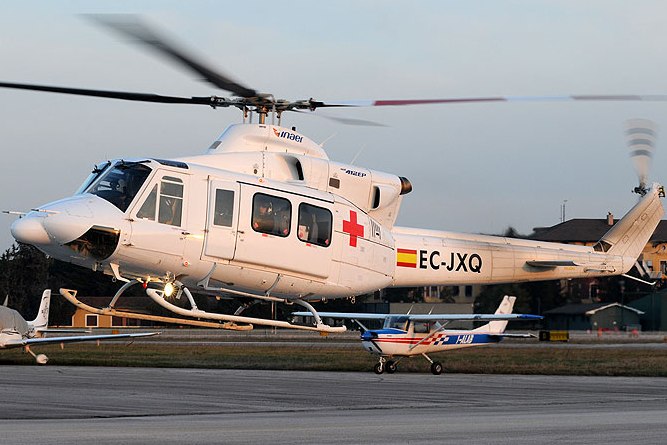
On 25 August 2022, at approximately 19:00 UTC, during wildfire suppression operations near Lobeira, Ourense, Spain, a loss of separation occurred involving two helicopters and one fixed-wing aircraft. The aircraft involved were a Bell 412 EP (registration EC-JXQ) and a Bell 412 (registration EC-HZD), both operated by Babcock, and a Thrush Aircraft S2R-T660 (registration EC-NET) operated by Plysa. No injuries were reported, and no damage was sustained by any of the aircraft or their crews.
Background
The wildfire had started the night of 24 August 2022. Aerial resources from both the Spanish Ministry for the Ecological Transition and the Xunta de Galicia were deployed. A coordination helicopter (AS355, registration EC-MVU) had been active until approximately 18:00 UTC. After it concluded its shift, another helicopter (EC-MVU) was activated from the Campiño base to assume coordination duties due to a secondary fire front that had reactivated in the northern area of the wildfire.
Upon arrival, the pilot of EC-MVU conducted a reconnaissance orbit and took over coordination of the aerial resources. In the northern flank, approximately 100 meters long, four helicopters and two fixed-wing aircraft were working. Two helicopters (EC-JXQ and EC-HZD) were operating from the Tabuyo base, one (EC-NKM) from Toén, and one (F-HERZ) from Xurés. They were performing a water pickup circuit from a nearby loading point about 75 meters away. The loading area was surrounded by hills, which hampered radio communications. The fixed-wing aircraft (EC-NET and EC-NLL) were performing ground-loading operations from the Doade base and had already completed two circuits, approaching for a third drop.
Incident
Just before 19:00 UTC, the Doade formation pilots had already dropped on the northern flank twice and were approaching for a third drop, which would be the last of the day due to sunset at 19:17 local time. Because helicopters were operating in the area, the Doade formation orbited to the northwest. They contacted the coordination helicopter and awaited clearance to drop. The coordinator asked if they had the helicopters in sight, and the pilot of EC-NET replied affirmatively. The coordinator then instructed the helicopters to clear the area, but a loss of separation ensued between the two Babcock helicopters (EC-JXQ and EC-HZD) and the Plysa airplane (EC-NET). The incident involved two consecutive losses of separation in flight.
Investigation
The Spanish Civil Aviation Accident and Incident Investigation Commission (CIAIAC) investigated the incident. The investigation concluded that the cause was deficient coordination and lack of message readback among the aerial means participating in the firefighting operations. This communication failure led to two consecutive losses of separation in flight.
Probable Cause
The probable cause, as stated by the investigation, was deficient coordination and lack of message readback among the aerial means participating in the firefighting operations, resulting in two consecutive losses of separation in flight.