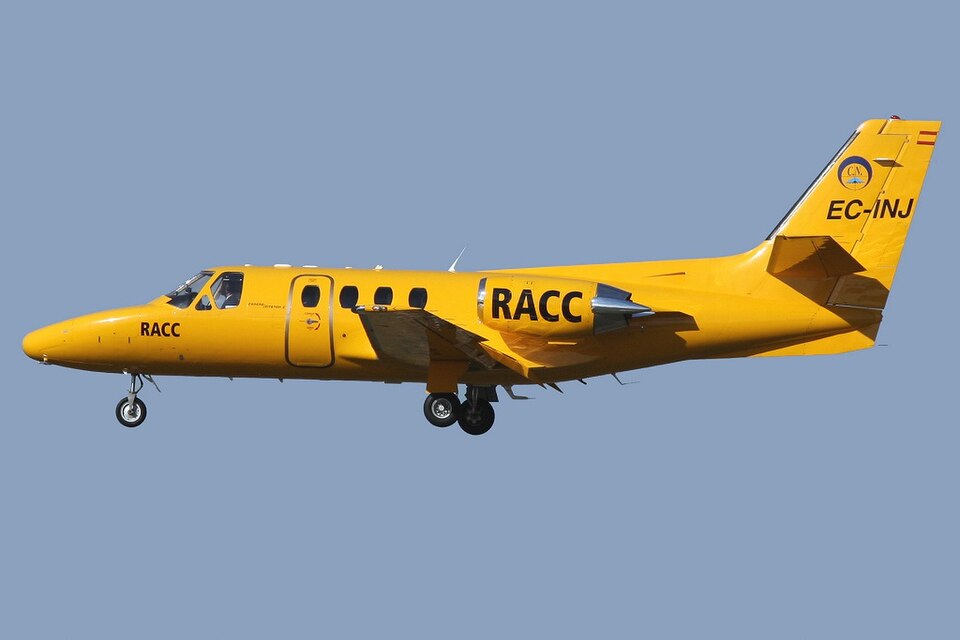
On December 19, 2007, a Cessna 500/501 Citation (registration EC-INJ) was involved in an aviation accident near Aeropuerto de Burgos (Burgos), ES. This summary draws on records from the Spanish Civil Aviation Accident and Incident Investigation Commission (CIAIAC).
A Cessna Citation C501 operated by Clipper National Air landed on a closed runway under construction at Burgos Airport on December 19, 2007. The aircraft struck concrete blocks, causing minor damage, while all nine occupants were uninjured.
Incident Overview and Flight Details On Wednesday, December 19, 2007, at 09:17 local time, a Cessna Citation C501 with registration EC-INJ, operated by Clipper National Air, landed at Burgos Airport (LEBG). The aircraft had departed Valencia Airport (LEVC) at 08:30 local time for a non-scheduled domestic passenger flight. The flight was crewed by a pilot-in-command and a co-pilot, and carried seven passengers. The aircraft was equipped with two Pratt & Whitney JT15D-1A engines. ## Approach and Landing Sequence The crew reported reaching flight level 280 after departure and proceeding directly to Burgos at cruising speed. The descent began approximately 70 nautical miles from the destination, and the IFR flight plan was cancelled when crossing flight level 140. The crew coordinated with other traffic on the airport frequency (122.40 MHz) to enter in first position. They sighted runway 24 at an altitude of 5,000 feet, between 10 and 12 nautical miles from the airfield, and conducted a direct approach with a left drift correction, using the onboard GPS to position themselves on the left base of the runway. The pilot stated that the active runway was determined based on the wind configuration from the last METAR received. ## Ground Collision and Aftermath The aircraft did not land on runway 24 but instead on a newly paved runway under construction, which was intended to be designated as runway 22 but had not yet entered service. This runway was marked as closed to traffic with three white plastic crosses, each secured to the ground by concrete blocks, positioned at the beginning, middle, and end of the paved surface. During the landing roll, the crew deployed reverse thrust and aerodynamic brakes. The aircraft passed over the middle cross and struck the concrete blocks with the nose gear first, followed by the main gear. This impact caused the left main wheel to burst and the nose wheel to detach. The crew disengaged reverse thrust, shut down the engines, and cut the electrical power. The aircraft continued to slide down the runway, dragging the nose gear, but remained under the pilot's control through differential braking. It came to a stop on the left edge of the runway, 1,460 meters from the start of the paved area. All nine occupants were uninjured and evacuated the aircraft on their own. The crew was unaware they had landed on a closed runway until airport emergency services arrived and informed them. ## Aircraft and Crew Information The Cessna Citation C501 was manufactured in 1977 with serial number 501-0086 and held a valid airworthiness certificate. It had a wingspan of 14.25 meters, a length of 13.26 meters, a height of 4.36 meters, and a maximum takeoff weight of 5,375 kg. The aircraft was not equipped with a cockpit voice recorder (CVR) or flight data recorder (FDR), as it was not required under JAR-OPS 1 due to its maximum takeoff weight and passenger configuration. The 44-year-old pilot-in-command held a valid commercial pilot license (CPLA) and private pilot license (PPLA), with type ratings for C501/551, instrument rating (IR(A)), and commercial flight instructor rating (CRI-SPA C501/551). He had 4,500 total flight hours, including 2,000 hours on type. The 26-year-old co-pilot held a valid CPLA, with multi-engine piston land, C501/551 type, and IR(A) ratings. He had 700 total flight hours, including 420 hours on type. Both crew members held valid medical certificates. ## Airport and Regulatory Context Burgos Airport is located 4 km west of the city, with an elevation of 897.5 meters (2,945 feet). The operational runway 06-24 is 1,339 meters long. The airport does not provide air traffic control services, and traffic must follow the visual approach chart. At the time of the incident, a new 2,100-meter runway was under construction, with an orientation of 43° 31' 55'' - 223° 31' 55'', to be designated 04-22. It had been paved in November and featured edge and centerline markings but no threshold or runway designation markings. The runway was marked as closed with three white plastic crosses, each 36 meters long and 15 meters wide, secured by concrete blocks. The construction project did not include provisions for closed runway markings, and no NOTAM was published regarding the works. ## Post-Incident Measures The following day, seven crosses with dimensions and spacing defined in ICAO Annex 14 were painted on the runway. The investigation revealed two other landings on the same runway under construction without damage: one on November 6, 2007, at 10:30 local time, and another on February 18, 2008, at 15:30 local time, after the new markings were painted. Both were commercial passenger flights. AIP AMDT 169/08, effective April 10, 2008, noted the existence of runway 22-04, specifying it was not usable for takeoffs or landings.