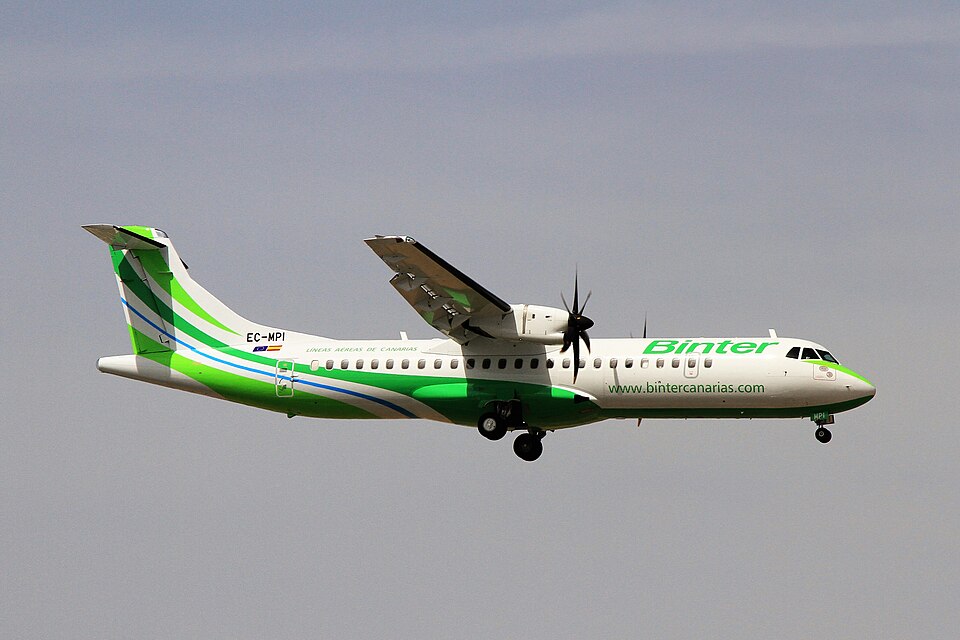
Engine blade fatigue forces aborted takeoff of ATR 72 at Tenerife North

Casualties unknown • Aeropuerto de Tenerife Norte (Santa Cruz de Tenerife), ES

A Pratt & Whitney Canada engine failure caused an ATR 72-212A to abort its takeoff at Tenerife North Airport after turbine blades fractured.

What happened

On 15 October 2019, an ATR 72-212A, registration EC-MPI, operated by Canarias Airlines, was performing a commercial takeoff from runway 12 at Tenerife North Airport (GCXO) bound for Gran Canaria. As the aircraft approached rotation speed, the crew heard an unusual noise from the right side accompanied by intense vibrations. Upon observing abnormal parameters for the right engine, the crew successfully aborted the takeoff maneuver.

The aircraft vacated the runway via taxiway E4 and returned to the parking stand. While the 46 passengers and crew were uninjured and disembarked normally, a subsequent inspection revealed scratches and damage to the aft section of the fuselage. Additionally, airport officials recovered various metal fragments from the runway and near taxiways E1 and E2, which had been ejected from the engine exhaust during the incident.

The investigation

Investigators examined the right engine, a Pratt & Whitney Canada PW127M, to determine the source of the mechanical distress. Metallographic and spectroscopic analyses were performed on the recovered fragments. The investigation also reviewed maintenance records and the implementation of existing service bulletins regarding turbine blade durability.

Technical analysis of the fractured components revealed that the material itself was free of pre-existing defects. However, the investigation found that the engine had not yet been updated with a specific part number recommended in a previous service bulletin, which was intended to improve resistance to corrosion.

Findings

  • The engine failure was initiated by a fatigue fracture of a single blade in the second stage of the power turbine (PT2).
  • This initial failure led to the subsequent overload fracture of several additional blades.
  • The investigation noted that operating in environments prone to salinity or contamination can decrease the service life of these power turbine blades.
  • At the time of the event, the engine had not yet been updated with the newer, more corrosion-resistant blade part number recommended by the manufacturer.

Probable cause

The engine failure was caused by the fatigue fracture of a second-stage power turbine blade, which subsequently triggered the overload failure of multiple other blades.

Frequently asked questions

What happened in the 2019-10-15 ATR-72 accident near Aeropuerto de Tenerife Norte (Santa Cruz de Tenerife), ES?

A Pratt & Whitney Canada engine failure caused an ATR 72-212A to abort its takeoff at Tenerife North Airport after turbine blades fractured.

What aircraft was involved and where did it happen?

The accident on 2019-10-15 involved a ATR-72, registration EC-MPI, at Aeropuerto de Tenerife Norte (Santa Cruz de Tenerife), ES.

What was the probable cause of the accident?

The engine failure was caused by the fatigue fracture of a second-stage power turbine blade, which subsequently triggered the overload failure of multiple other blades.

Loading the flight search…

What you can do on Flight Finder

  • Search flights between any two airports with live fares.
  • By aircraft — pick a plane model (e.g. Boeing 787, Airbus A350) and see every route it flies from your origin.
  • Route map — click any airport worldwide to explore its destinations, or draw a radius to find nearby airports.
  • Global aviation safety — aviation accident database, 40,000+ records since 1980, with map and rankings by aircraft and operator.
  • NTSB safety feed — recent U.S. aviation accidents and incidents from the official NTSB CAROL database, updated daily.