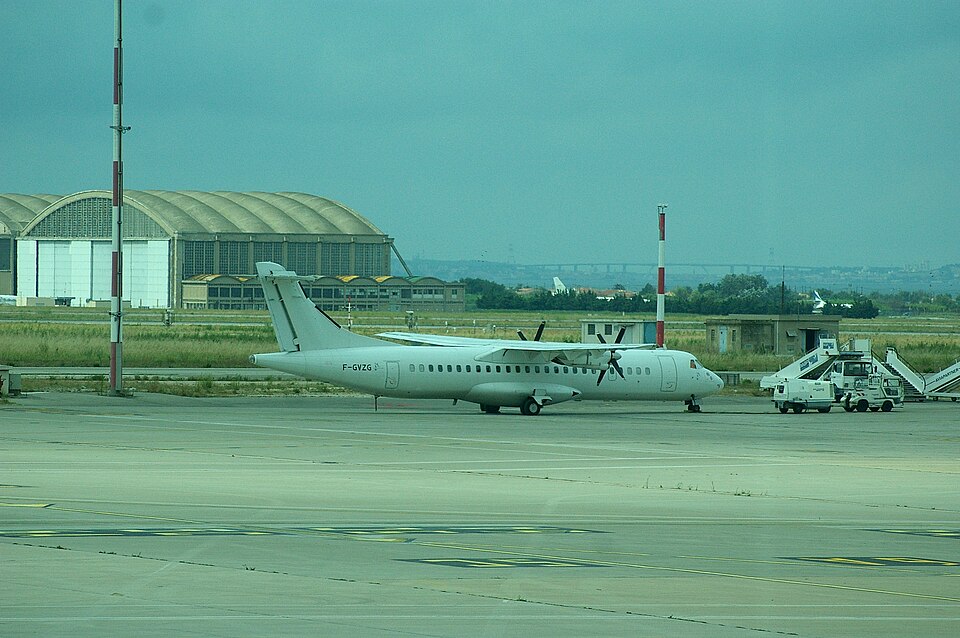
History of the Flight
The flight departed Lyon Saint-Exupéry airport at 14:02 UTC with two cabin crew and 25 passengers, destined for Marseille Provence. The crew conducted an ILS approach to runway 13L. Twelve seconds after wheel touchdown, at about 70 kt, the captain detected an anomaly. Three seconds later, he announced a fault on both MFCs and reported loss of control. The steering wheel did not respond, and braking seemed abnormal. He engaged emergency braking. During the landing roll, the aircraft deviated right then left, stopping two-thirds along the runway and slightly off. The nose gear was found at 90° to the longitudinal axis. Passengers disembarked via bus. Post-incident inspections showed hard braking marks and MFC 1B and 2B FAULT lights illuminated.
MFC System Description
The ATR 72 has two independent MultiFunction Computers (MFCs), each with two modules (A and B). They process signals from various aircraft systems and manage warnings via the Centralized Crew Alerting System (CCAS). In case of a fault on one or more modules, corresponding amber lights appear on the overhead panel and Crew Alerting Panel (CAP), and the Master Caution light flashes.
Fault and Consequences
Recorded data indicated that after landing, the power levers were in the flight idle notch, meaning the IDLE GATE automatic function operated. The MFC 1B+2B fault occurred after wheel touchdown. Simultaneous loss of these modules leads to loss of several functions: visual alerts on CAP (except certain red lights), aural alerts, IDLE GATE automatic function, stall warning and stick shaker, nose wheel steering, and touchdown protection. Anti-skid remains operative.
Similar Events
The BEA reported multiple similar events before and after this incident, involving faults on MFC 1B+2B during landing roll, causing loss of yaw control or steering. Many crews regained control after reinitializing MFCs. Events occurred on several aircraft: F-GVZC (25/02/2011), F-GPYM (28/09/2011), EI-REL (18/10/2011), F-WWXX (10/2011), F-WWEB (04/11/2011), F-GVZC again (04/12/2011), F-GVZM (05/12/2011), and F-GPYL (02/11/2012). After June 2015, only three events reported.
Technical Examinations
Analysis of flight data and cockpit voice recorder (CVR) from F-GVZG and similar events showed that a fault on the MFC audio module was systematically recorded. The "triple click" aural warning was often partially emitted (only one click) simultaneously with the MFC 1B+2B fault. Additional examinations revealed that microprocessors handling warning generation could transmit erroneous information when synchronizing two modules about to generate simultaneous warnings. The error was caused by a failure in the software managing the MFC function.
Probable Cause
The runway excursion on landing was the result of the loss of control of the nose gear and of it turning so that it was perpendicular to the longitudinal axis of the aeroplane. The loss of control of the nose gear was due to a simultaneous double fault on MFCs 1B and 2B, detected by the crew during a critical flight phase. The cause of this double fault was identified and was the result of a system error during the synchronization of the generation of aural warnings for the crew. The loss of braking power felt by the captain could not be explained by the investigation.
Modifications
The manufacturer published Operations Engineering Bulletin No. 28 in April 2015 to inform crews of the procedure. A new MFC software standard 6 was developed to eliminate the anomaly, available as retrofit since June 2015 and installed on production line since December 2015.