Flight History
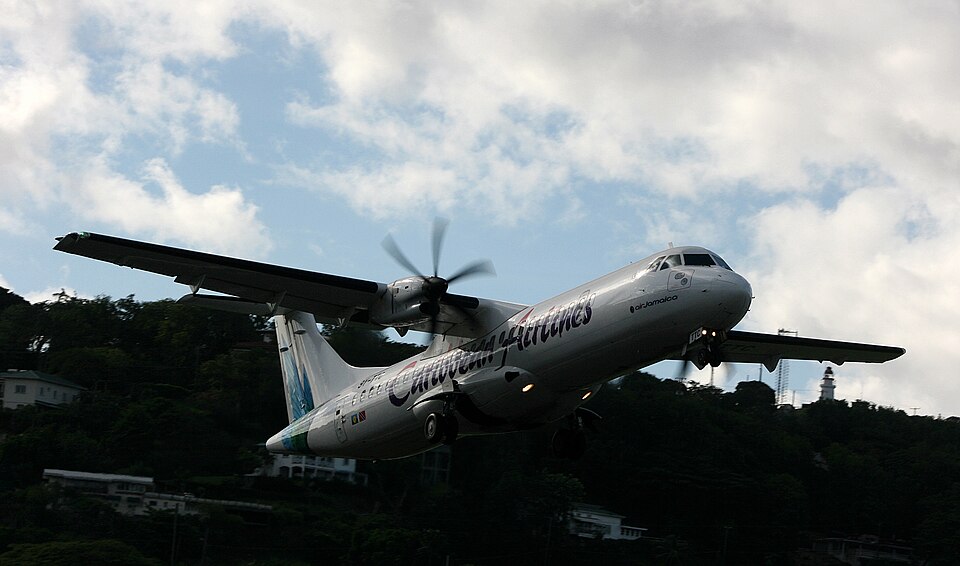
On 4 May 2014, an ATR 72-212A, registered 9Y-TTC, operated by Caribbean Airlines, was on a commercial flight to Piarco Airport in Trinidad and Tobago. During the top of descent, the crew reduced engine power to flight idle while the aircraft speed was approximately 246 knots, near the maximum operating speed of 250 knots. Strong vibrations were felt, followed by a warning associated with the electronic propeller control of the right propeller. After landing, the drive shaft of the right engine AC wild generator was found ruptured and replaced. Ground tests on both engine/propeller assemblies showed no abnormalities.
On the following day, the aircraft operated a flight without incident until the landing roll, when the crew heard a loud vibration as the power levers were moved from flight idle to ground idle. Subsequent maintenance included three ground tests that revealed nothing abnormal, followed by replacement of the right propeller valve module. During a fourth ground test, when the power levers were moved to reverse, vibrations appeared and the engines were shut down. After shutdown, blades 1, 2, 5, and 6 of the right propeller were in the feather position, while blades 3 and 4 remained in the reverse position. Disassembly later revealed that the trunnion pin of blade 4 had ruptured and the propeller blade actuator yoke plate was damaged.
Investigation Findings
The BEA investigation examined the damage and found evidence of alternating overloads that caused damage to the yoke plates and a final overload in one direction that resulted in the trunnion pin rupture. The precise cause of these overloads could not be determined, but several contributing elements were identified: a retention force due to ball bunching, significant loads from trunnion pins striking the yoke plate ears under cyclic loading at high speed near VMO with power levers at flight idle, and unplanned operation of the propeller pitch change control loop affected by cyclic loading and friction.
The investigation also noted that the maintenance operations performed on 9Y-TTC after the initial vibration events did not identify the damage to the propeller mechanism. The circumstances and damage were similar to those observed in a serious incident on 18 September 2013 in Indonesia involving an ATR 72-212A registered PK-WFV.
Similar Events
Seven similar vibration events on ATR 72-212A aircraft had been reported in preceding years. In nearly all cases, rupture of a blade trunnion pin and damage to the propeller blade actuator forward yoke plate were observed. The BEA issued safety recommendations to EASA and FAA regarding operational limitations, pilot awareness, and maintenance procedures.