History of the Flight
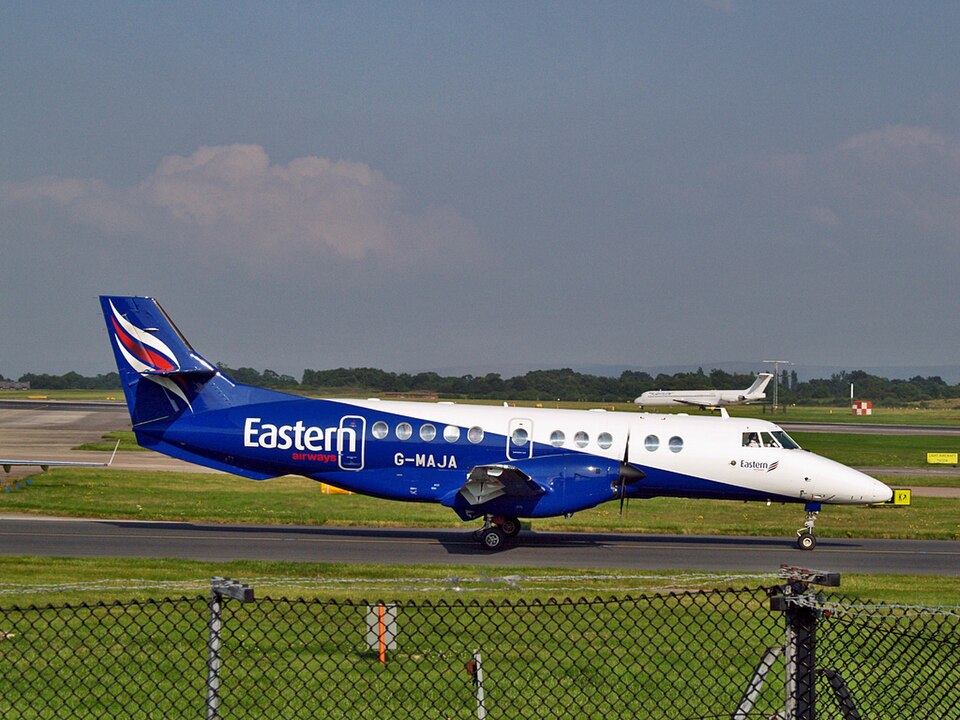
The aircraft, a Jetstream 4100 registered G-MAJA, departed from Hamburg Airport with an overloaded baggage compartment and a centre of gravity outside the aft limit of the operating company's approved flight envelope, though within the manufacturer's less restrictive envelope. On the morning of the incident, the commander and first officer flew from Humberside Airport to Hamburg Airport with a cabin attendant, no passengers, and no cargo. While taxiing prior to departure, the commander noticed the aircraft meandering about the taxiway centreline without crew nose wheel steering (NWS) input. The aircraft arrived at Hamburg at 1029 hrs and was scheduled to depart with 10 passengers and luggage at 1200 hrs for a chartered flight to Manchester.
After the aircraft was catered and refuelled, passenger baggage arrived. The commander noted several large and heavy bags and asked if they had been weighed; the handling agent said they had not been weighed and were not planning to weigh them. The bags were loaded into two baggage compartments (Holds 4 and 6), which were filled to volumetric capacity. Remaining bags, about five, were stored in the passenger cabin. The commander realized the centre of gravity would be significantly aft and asked the cabin attendant to seat passengers in forward seats. Loading information was passed to the first officer, who completed a manual loadsheet, which the commander signed. The passengers boarded, and the commander noted they had a significant amount of hand baggage.
Baggage Loading
The commander estimated the weight of the baggage holds as the maximum allowed: 330 kg in Hold 6 and 158 kg in Hold 4, and these figures were entered on the loadsheet. After the incident, the handling agents weighed the hold baggage: 30 items totalled 610.9 kg, which is 122.9 kg greater than the maximum combined hold weight. The exact distribution is unknown, but from an engineer's recollection, Hold 4 was likely near its 158 kg capacity, and Hold 6 likely contained approximately 453 kg. The hold baggage taken into the cabin and strapped to seats was not shown on the loadsheet, considered part of allowed hand baggage (6 kg per person). One bag of about 5 kg was placed in the wardrobe behind the first officer's seat.
Passenger Loading
Before boarding, the commander asked the cabin attendant to seat passengers forward. The loadsheet showed nine passengers in Bay A and one in Bay B. However, the cabin attendant did not seat anyone in Row 1 due to unpopularity, and excess baggage occupied some seats in Rows 2 and 3. Consequently, Bay A contained two passengers, Bay B seven, and Bay C one. This difference significantly affected the actual centre of gravity. The actual load placed the centre of gravity aft of the operating company's flight envelope, into the 'unsafe' region for both takeoff and landing. The manufacturer's flight envelope is less restrictive, and using theirs, the centre of gravity fell within the aft limit.
Flight and Incident
After a normal start, the commander taxied the aircraft to Runway 33 at Hamburg; no meandering occurred, and NWS operated normally. During taxi, the ANTI-SKID caption illuminated; the switch was recycled two or three times before it extinguished. The flight proceeded without incident to Manchester Airport. An ILS was flown to Runway 06R in benign weather: light variable wind, 10 km visibility, cloudbase 2,000 ft, temperature +16°C. After the ILS approach, the autopilot was disengaged, and a smooth touchdown was achieved on the runway centreline. Spoilers deployed, and reverse power was selected.
Almost immediately after touchdown, the aircraft began to meander about the runway centreline, and the oscillation rapidly became more progressive. The commander initially attempted to control the instability with rudder, but with no effect, he resorted to NWS via the tiller. The tiller moved freely, but he could not control heading. Shortly after, the aircraft yawed rapidly left and departed the runway. Full wheel braking and rudder were applied. The aircraft decelerated rapidly on furrowed grass and stopped after about 10 seconds. The commander made a public address to reassure passengers and opened the flight deck door to check the cabin; the cabin attendant gave a 'thumbs up'. After airport fire and rescue services arrived, engines were shut down, passengers were released. No smoke, fire, or apparent damage occurred.
Flight Recorder Analysis
The aircraft was fitted with a flight data recorder. Analysis showed that about 30 seconds before touchdown, the aircraft was established on glideslope at 295 ft agl, autopilot engaged, flaps 25°, 121 kt IAS (Vref +14 kt), descent rate about 670 ft/min. At about 80 ft agl, the autopilot was disconnected. Coincident with disconnect, about 12 seconds before touchdown, the aircraft pitched nose down from -5° to -7°. Nose-up elevator increased pitch to -1°. Two further pitch oscillations occurred before the flare. Just before touchdown, there was a yaw rate to the left of about 0.5°/s, then a bank to the right with 2.5° roll attitude at touchdown as yaw rate reduced to zero. Touchdown pitch attitude was +2.5°, airspeed 107 kt (Vref), normal acceleration peaked at 1.25 g.