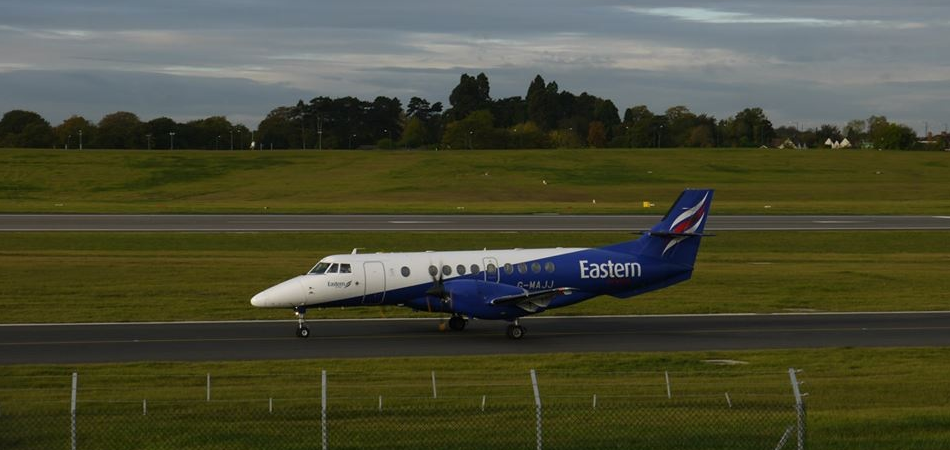
Incident During Pushback
On 28 May 2012 at approximately 1455 UTC, G-MAJJ, a Jetstream 4100 (serial number 41024, year of manufacture 1993) powered by two Garrett TPE331-14GR-807H turboprop engines, was being pushed back from Stand 209 on Apron 2 South at Brussels National Airport, Belgium. The pushback proceeded normally until the aircraft came to an abrupt halt and the shear pin on the towbar broke. The tug driver, a qualified pushback operator working on this type for the first time, reported that after about 100 m he saw the nosewheel lift up and almost immediately drop back down with the nose towards the right. The shear pin had broken, leaving the towbar head to pivot freely. No obstacles were present. The ground agent, in contact with the pilot via headset, observed the nosewheel turn and the towbar become misaligned.
Decision to Continue
The captain asked the ground agent to check for damage. The agent said he saw none, and the captain decided to continue the flight. The pilots had not applied brakes, and a CCTV review showed no external cause. The aircraft then operated eight sectors before damage was discovered.
Subsequent Flights
During the climb out of Southampton Airport after the pushback, the crew experienced a low, steady thumping below the cockpit after gear retraction, continuing until approximately FL70. After landing at Aberdeen, the captain reported a clunking sound from the nosewheel after takeoff; an engineer found the nosewheel misaligned and corrected it per the maintenance manual. A 5-Day Service Check was completed that evening.
On 29 May, the aircraft operated five sectors. On the second and third, crews noticed a clunk in climb between FL50 and FL100, described as metal stretching or crushing a can. On the fourth sector, a new crew felt a clunk through their feet between FL50 and FL60. After landing at Aberdeen, a visual inspection found no damage. On the return leg to Southampton, a clunking sound was heard during nose gear lowering. No defects were entered in the Technical Log.
On 30 May, during climb from Southampton to Aberdeen at about 5,000 ft, a clunking noise was heard. No handling difficulties occurred. After landing at Aberdeen, damage was discovered: the rear pressure bulkhead of the nose landing gear bay, lower fuselage skin and keel plate aft of the nose gear bay, and supporting frames were damaged. The aircraft was removed from service for inspection.
Inspection and Procedures
The operator's Ground Operations Manual (GOM) stated that if a shear pin breaks, the tug should be slowed and stopped and the flight deck informed. The aircraft manufacturer's AMM specified that the tractor should weigh between 5,000 lb and 10,000 lb (approx 2,300 kg to 4,500 kg). The tug used was a Schopf F100, empty weight 14,000 kg. The ground handling agent did not have access to the AMM and followed the GOM and Ground Handling Instructions, which did not refer to tractor type.
Pre-flight walk-around inspections per the Operations Manual require checking skin and antennas in the nose gear area. The 5-Day Service Check includes a general visual inspection of external fuselage areas. No defects were reported prior to the damage discovery.
Flight Recorder Analysis
The CVR record of the pushback was overwritten after eight subsequent flights. The FDR did not record brake pedal position or hydraulic pressure. Analysis of all recorded flights found no evidence of heavy landing on the nose gear or rapid de-rotation. One landing on 29 May at Brussels had normal acceleration 0.06g above the hard landing limit of 1.5g, but vertical descent rate was below the limit of 10 ft/sec.