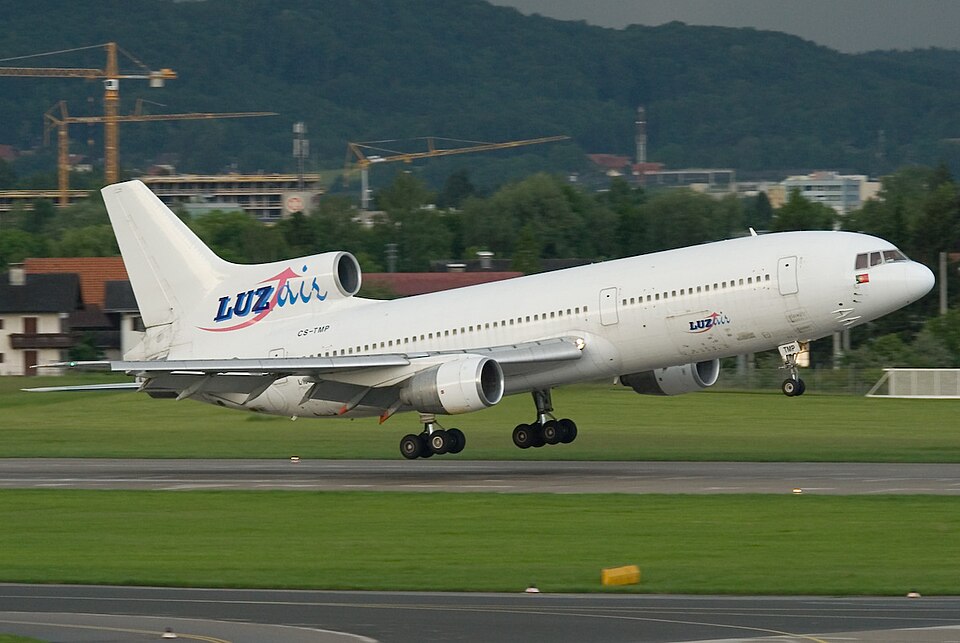
Aircraft and Flight Details
The accident involved a Lockheed L1011-500 Tristar, registration CS-TMP, year of manufacture 1983. It was powered by three Rolls-Royce RB 211-524B turbofan engines. The flight was a public transport positioning flight from Lisbon Airport to Stansted Airport, with 13 crew on board and no passengers. There were no crew injuries. The commander held an Airline Transport Pilot's Licence and a Type Rating Instructor qualification, aged 54, with 11,300 total flying hours (1,200 on type). The left-seat pilot (being upgraded to commander) had 5,700 hours (1,800 on type). The right-seat pilot held a Commercial Pilot's Licence with 337 hours (37 on type). An experienced flight engineer was also present.
Sequence of Events
The aircraft departed Lisbon at 0845 hrs. The positioning flight served as a final line check for the left-seat pilot's command upgrade. Prior to descent, the crew received ATIS information indicating Runway 23 in use with wind 260°/08 kt, visibility >10 km, cloud broken at 5,000 ft, temperature 21°C, dew point 6°C, QNH 1020 hPa. The crew planned a Category II Autoland as part of the upgrade.
During the approach, Autopilot (A/P) 'B' was engaged initially, then A/P 'A' was also engaged. The aircraft was fully configured with gear down and Flap 33 before glideslope capture. At about 3,000 ft amsl, the aircraft was established on both localiser and glideslope. The AutoThrottle System (ATS) was engaged, and speed appeared steady at approximately 150 kt (Vref calculated as 145 kt).
At 1,500 ft amsl, the right-seat pilot called "Approach and landing, I have control" per company procedure. At about 400 ft radio height, A/P 'A' disengaged, displaying an amber 'NO DUAL' annunciation. The commander instructed re-engagement, which was successful. At decision height (100 ft), the left-seat pilot responded "Landing, I have control". At 50 ft radio height, the right-seat pilot observed 'FLARE' on the AFCS Mode Panel. The left-seat pilot felt thrust levers retard. The commander perceived a normal flare but continuing beyond the usual 7° nose-up attitude. Touchdown was firm, and a metallic noise was heard from the rear. The A/Ps disconnected, the left-seat pilot lowered the nosegear and selected reverse thrust. During the landing roll, ATC advised that the tail had struck the runway.
Damage included scoring and deformation to the underside of the aft fuselage, damage to the No 2 engine translating cowl and hot stream duct.
Flight Data Recorder Analysis
The FDR data showed that at A/P 'A' engagement (about 3,750 ft amsl, 5 minutes before touchdown), localiser and glideslope deviation became active, and engine pressure ratios (EPRs) changed, consistent with ATS activation. During the final approach, the aircraft was established at about 150 kt with a descent rate of 800 ft/min, pitch attitude averaging 6° nose up varying ±3°. Approximately 30 seconds before touchdown at 350 ft agl, A/P 'A' disconnected and re-engaged. Thereafter, EPRs remained fixed, pitch increased, airspeed reduced, and the aircraft diverged below glideslope. At 50 ft agl (4 seconds before touchdown), pitch was 11° nose-up, airspeed 128 kt. At touchdown, pitch exceeded 15° nose-up, recorded airspeed 120 kt.
ATC and ILS Information
The crew did not inform ATC of the autoland. No external influences were identified: Runway 23 ILS was flight-checked successfully in May 2003, no work had been done in the protected area, and other aircraft reported normal ILS indications. The taxiing aircraft after CS-TMP was holding at the Cat III holding position. No vehicles were in the protected area.
Operational Procedures
The aircraft was cleared for Cat II/III operations as a 'Fail Operational' system. Company procedures required the captain to monitor the approach, the first officer to fly using maximum auto flight capability, and the flight engineer to cross-check. For a Cat II automatic landing, one A/P and one Flight Director with dual display were required; the ATS was not required. At 300 ft AAL, abnormal operations should trigger decisions.
The auto throttle system was inoperative during the final approach, but the crew did not detect the consequent diverging parameters of aircraft attitude and airspeed.