Incident Overview
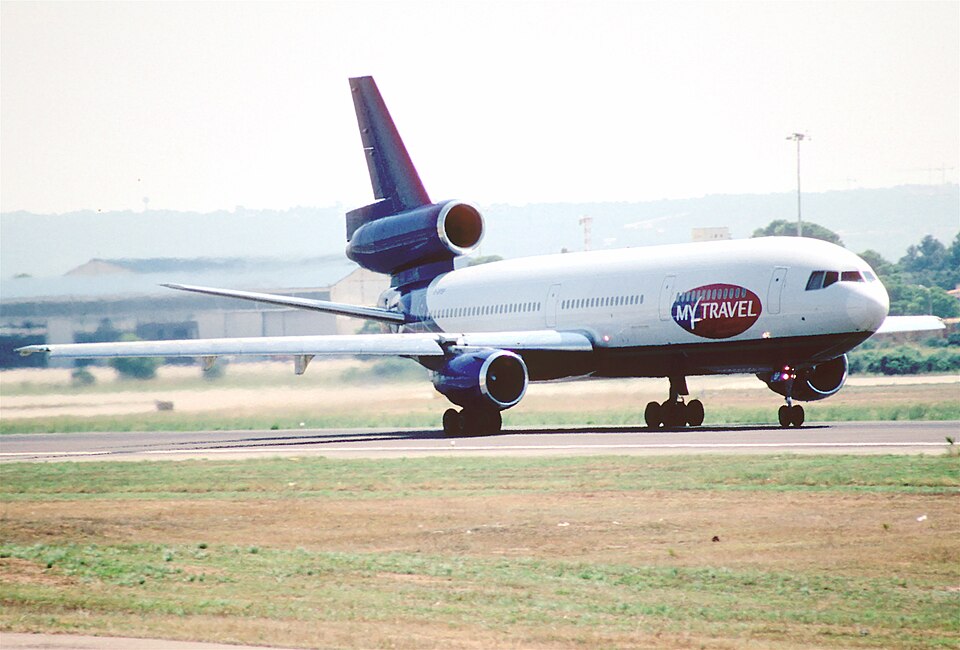
On 29 August 2003, a McDonnell Douglas DC-10-10, registration G-DPSP, operated a passenger flight from Lanzarote to Manchester Airport. The flight was uneventful until after landing, when air traffic control informed the crew that debris had been found on the runway. Following passenger disembarkation, ground engineers discovered that the No 8 main wheel tyre, though still inflated, had shed its tread. Additionally, minor damage was found on the underside of the right wing near the main landing gear, including a hole in a honeycomb access panel. Dents and missing paint were also observed on the wing and landing gear. ATC at Lanzarote was requested to inspect the runway, but no feedback was received.
Tyre Investigation
The affected tyre was returned to the manufacturer for analysis. The investigation revealed that the tyre had thrown most of its tread, and a portion of the outer casing on one sidewall had separated. This separation was visible between the casing plies. The inner liner was wrinkled, and an air needle inspection indicated a leak in the inner liner.
Manufacturer's Findings
The manufacturer concluded that premature fatigue or over-deflection had caused the inner liner to leak, allowing nitrogen to enter the casing at a rate exceeding its venting capacity. The resulting pressure buildup either caused or inflated a separation between the plies. Once the separation grew sufficiently large, the forces acting on the tyre led to tread separation. The tyre was in its fourth retread (R04) at the time of failure. Shearography performed at the last retread showed no anomalies; bead-to-bead shearography was scheduled for the end of the R04 life. The manufacturer plans to conduct bead-to-bead shearography at the third retread for future tyres to detect sidewall fatigue earlier. Additionally, the manufacturer noted that the mating tyre should be scrapped, as it would have sustained damage from overload.