Incident Description
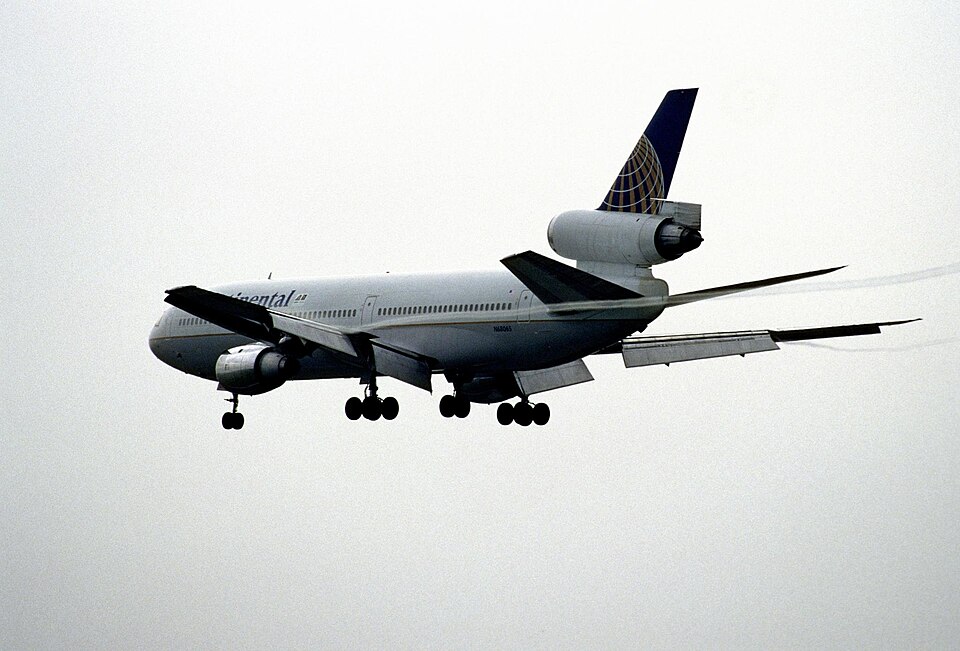
On 8 March 1998, at 1145 UTC, a McDonnell Douglas DC-10-30, registration N68065, was preparing for a scheduled passenger flight from Manchester Airport to Newark Airport, USA. The crew reported for duty at 1000 hrs. The aircraft was serviceable and the forecast meteorological conditions were good, with a surface wind of 090°/15 kt and temperature +6°C. Runway 06 was in use. At 1136 hrs, after being transferred to Tower frequency, a strange odour was noted in the cabin and reported to the flight crew. The flight crew detected a slight smell of gasoline. The commander instructed the flight engineer to ventilate the aircraft and announced to passengers that they would return to the stand. At 1139 hrs, the first officer requested permission to taxi back to the stand. After a hold for another aircraft, the DC-10 was cleared at 1142 hrs to enter the runway, backtrack, and clear at intersection Bravo. As the aircraft turned onto taxiway Bravo at 1144:42 hrs, the Tower controller saw vapour from the No 2 engine and informed the commander that the aircraft appeared to be venting fuel. The bird control patrol had also observed vapour/fuel from the No 2 engine and informed Ground movements at 1144:35 hrs. At 1445:57 hrs, the commander halted the aircraft on taxiway Bravo at the intersection with taxiway Charlie and requested the Airport Fire Service (AFS) due to a possible fuel leak. Inside, fumes became more noticeable but no flight deck warnings or visible smoke appeared. At 1446:10 hrs, ATC initiated a Ground Incident and fire tenders arrived promptly.
Emergency Evacuation
Upon AFS arrival, the chief fire officer instructed the crew to change frequency to 121.6 MHz. The commander reported fumes in the cabin and was advised that fuel was running from the No 2 engine. Shortly thereafter, a fire started in the No 2 engine. The chief fire officer suggested evacuation, which the commander immediately initiated. Emergency slides deployed. ATC was not advised of the evacuation. Fire crews discharged media onto the engine, extinguishing the fire. The evacuation of 239 passengers (including 3 infants) and 14 crew members was completed with only two minor injuries. However, problems occurred with slides: the door 3L slide's outboard section failed to inflate; and door 1R slide had a steep angle, requiring firemen to hold it. Slides at doors 2L, 2R, and 4R were tilted by wind but held down by firemen.
Cause of Fire
Preliminary information indicated the probable cause was an internal failure of the fuel cooled oil cooler (FCOC) on the No 2 engine, allowing fuel to leak into and flood the engine lubricating system before affecting the vent system. This was confirmed when sectioning revealed a large rupture in a fuel matrix tube, permitting pressurised fuel to enter the oil system. Fuel vapours then entered the oil vent system and ignited in the jet pipe. The matrix tube rupture occurred near the end of a tube group adjacent to a central divider plate. Fatigue cracks were found on each side of the divider plate where it joined the casing. These cracks allowed the plate region to flex due to pressure fluctuations, causing repeated contact with adjoining fuel tubes, leading to fretting, thinning, cracking, and rupture. The failure mode was identical to a previous failure on DC-10-30 G-NIUK, reported in AAIB Bulletin 4/99. Metallurgical examination revealed similar deficiencies in divider material strength, attributed to failure to meet specification.
Slide Malfunctions
After the incident, slides were removed. The inflation cylinder for the door 3L outer slide was still fully charged. Manual discharge inflated it normally. AAIB examination found no obvious defect explaining automatic inflation failure. However, a steel cable lanyard connecting the manual inflation handle to the discharge head was uncoupled at a barrel-type joiner. The ball and barrel were separated, with the ring nut still on the barrel, suggesting intentional disconnection at some point. The manual inflation handle was still stowed. No attempt was made during evacuation to manually inflate that section. Thus, the disconnection did not account for the failure.