Introduction
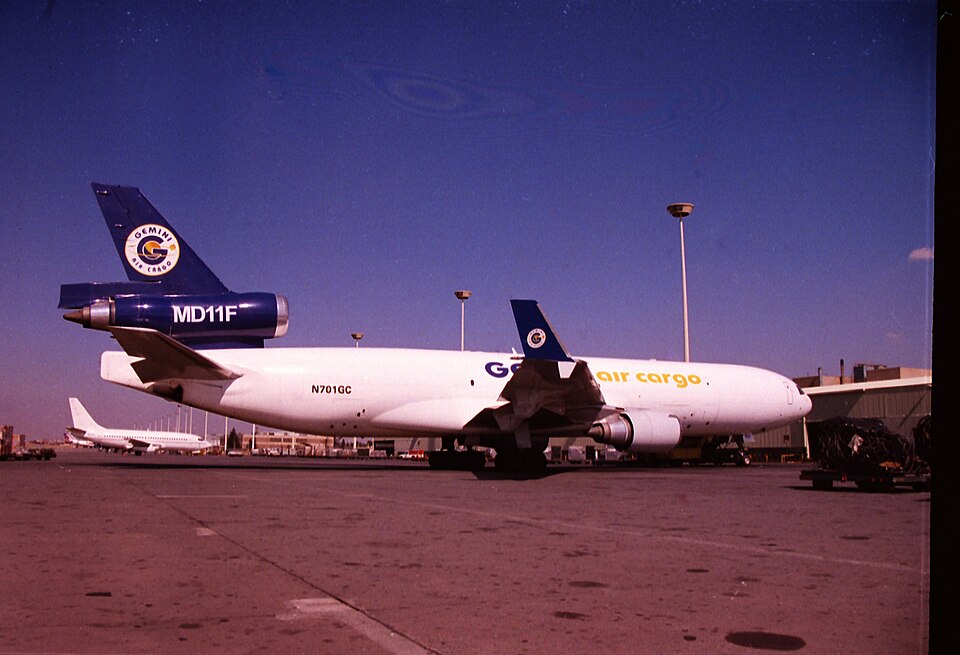
On 3 December 2005, a McDonnell Douglas MD-11 cargo flight, registration N701GC, experienced an incident during its approach to Nottingham East Midlands Airport. The aircraft, equipped with three GE CF6-80 turbofan engines and manufactured in 1991, was operating a commercial cargo flight from Cologne (Bonn) Airport. The crew consisted of three members: a commander, a first officer as Pilot Flying (PF), and another first officer seated on the jump seat. No passengers were on board. There were no injuries and no damage to the aircraft.
History of the Flight
The flight was uneventful until descent. The crew obtained ATIS information 'F', which reported cloud broken at 2,500 ft amsl and a QNH of 973 mb. They briefed for an ILS approach to Runway 27. After checking in with East Midlands Approach at flight level 80, the controller advised that the current ATIS was now information 'G', with the only change being QNH increased to 974 mb.
At 23 nautical miles, the aircraft was cleared to descend to 3,000 ft on the QNH of 974 mb. The crew acknowledged correctly. During the descent, the crew selected approach mode, but the aircraft began turning left away from the localiser. The crew reselected heading and approach mode before configuring for landing. As the aircraft descended to a cleared altitude of 2,000 ft, the handling pilot reported seeing the PAPIs.
After reporting established on the ILS, the crew was transferred to East Midlands Tower. The tower controller asked for an altitude report and then questioned the altimeter setting, having noticed on radar that the aircraft appeared lower than normal. The crew responded that they were at 2,000 ft. ATC asked them to check that 974 mb was set on the altimeter. The crew acknowledged and corrected the altimeter settings, which were found to be still on the standard setting of 1013 mb. The subsequent landing was uneventful.
Investigation
The AAIB was notified 11 days after the incident via a Mandatory Occurrence Report. By then, Flight Data Recorder and Cockpit Voice Recorder data were unavailable. However, RTF and telephone voice recordings from East Midlands ATC, along with a radar recording from the Clee Hill area radar, were obtained.
RTF recordings confirmed that the correct QNH was passed by ATC and acknowledged by the crew. The telephone recording captured the commander contacting ATC after landing, acknowledging that although the setting was passed, the crew had not set the QNH on the altimeters. The radar recording showed the aircraft leveled at 918 ft amsl (718 ft agl) at 7 nm from the runway threshold and maintained that altitude until glideslope intercept.
Analysis
The incident resulted from an omission by the crew to set the QNH on the altimeters, even though it was correctly passed by ATC and acknowledged. Shortly after acknowledging the QNH, the crew noticed the aircraft turning away from the expected heading, distracting them. Their attention focused on monitoring lateral position, and no one realized the Descent/Approach checklist had not been completed. At night and in sight of the PAPIs, it was difficult to visually appreciate the lower altitude. The three altimeters all indicated the same altitude, raising no concerns. The radar altimeter was not part of any crew member's scan.
The company investigation noted that the crew had been distracted from primary aircraft control by a navigation problem, with a subsequent loss of situational awareness. The tower controller's close monitoring and effective action identified the discrepancy.
Company Response
Upon receiving the commander's report, the company removed the crew from flying status and required additional ground and simulator training before a line check. The crew developed and conducted a briefing for other company crews on lessons learned. A Flight Operations Bulletin was circulated, emphasizing completion of all checklists and setting QNH after ATC clearance to an altitude. The company also reviewed aspects such as correct terminology for being established on the ILS and the inclusion of radar altimeter in crew scan. No change to radar altimeter callouts was implemented.
Conclusion
The investigation, by both the company and the AAIB, indicated ways to reduce the probability of a similar incident.