History of the Flight
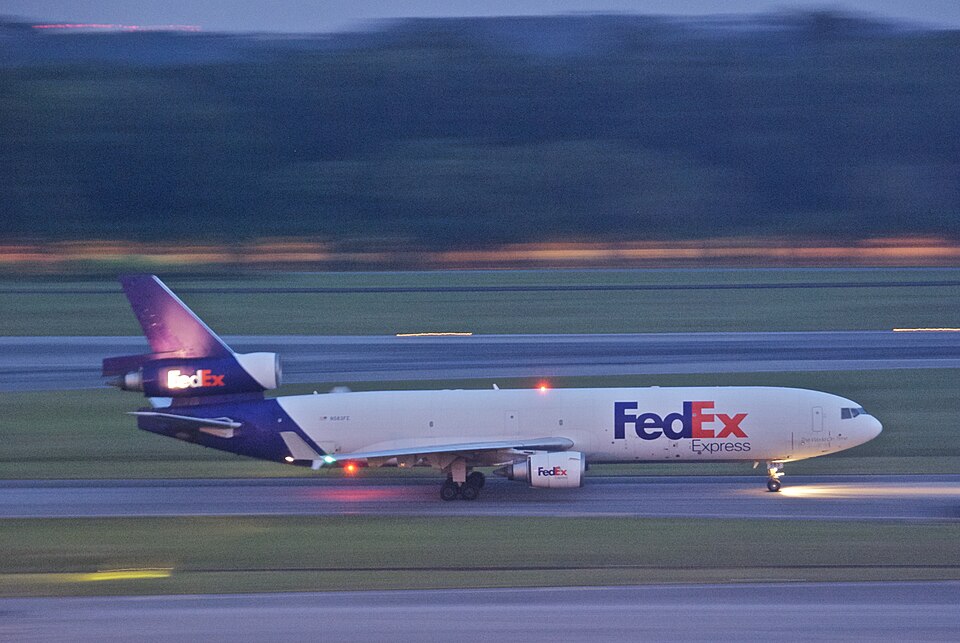
A McDonnell Douglas MD-11F, registration N583FE, was conducting a cargo flight from Paris Charles De Gaulle Airport to Stansted, Essex, with a subsequent leg to Newark, New Jersey. The crew comprised a training captain, a first officer under training (the handling pilot), and a relief first officer. The operator's normal landing flap setting was 35°, but the trainee first officer was required to perform a full flap landing, so the crew planned to use flaps 50° for the landing at Stansted.
The flight from Paris was uneventful until the approach to Runway 23 in fine weather. At approximately 4,000 feet, flaps were selected to 35°, and the first officer noticed a need for a small amount of rudder trim to maintain balance. When flaps were further extended to 50°, the captain felt a thump, similar to a birdstrike. Subsequently, the first officer required substantial right aileron to keep the wings level. The crew retracted flaps to 35°, and the need for right aileron significantly diminished. After a brief discussion, they re-selected flaps to 50° while monitoring the Configuration Page on the Electronic Flight Instrument System (EFIS). The need for right aileron reappeared, but all indications, including flap positions, appeared normal. The crew retracted flaps to 35° and completed a normal landing. During taxi, after retracting the flaps, the Electronic Instrument System alerted with 'HYD 2 QTY LO' followed by 'HYD 2 FAIL'.
Post-landing inspection revealed a large section of the left inboard flap vane missing. A fragment was later recovered from the village of Thaxted, approximately 6 miles north-east of Stansted. Digital Flight Data Recorder (DFDR) data showed that just over 50% of full right aileron travel was required to maintain level flight with flaps 50°, reducing to about 15% after retraction to 35°.
Engineering Investigation
The inboard flap vane, an aerofoil section attached to the leading edge of the inboard trailing edge flap, is supported at three positions on spring-loaded tracks. Examination revealed the outboard half of the left inboard flap vane missing, along with its attachment fittings at the outboard and centre positions. The inboard section remained attached, and the inboard and centre vane tracks showed significant distortion. Retraction of flaps during taxi caused damage to the flap shroud structure and the No. 2 hydraulic system.
Upon dismantling, a locking (retainer) plate and nut, each with part of a broken locking wire attached, were found inside the flap in the pocket for the vane outboard track. No other attachment parts were found; for these parts to have been retained, detachment must have occurred while the flap was retracted. Subsequent flap operation would have allowed remaining attachment items to fall.
Scanning Electron Microscope (SEM) analysis of the fractured lock wire indicated the material was consistent with required specifications (MS20995C32 and ASTM A580, annealed and passivated corrosion-resistant steel). Workmanship appeared adequate. Both strands of the wire fractured in a brittle manner consistent with fatigue, and evidence of a notch or groove was present at one fracture, co-located with the other. It is possible the wire was accidentally nicked. The fracture position suggested rubbing contact with a corner of the nut, which may have contributed to the nick and subsequent fracture.
It seems probable that the vane outboard rail detached before the approach to Stansted, possibly accounting for the initial slight trim requirement at flaps 35°. With the vane attached only at the inboard and centre positions, aerodynamic forces caused the vane to fail when flaps 50° were deployed. The loss of the outboard half of the vane created a lift asymmetry between the left and right wings, necessitating right aileron input. Retraction to flaps 35° reduced this asymmetry.
Normally, there was no maintenance requirement to disturb the outboard attachment area, and only routine visual inspections were conducted. A Special Inspection in March 2002 to check for cracks in the flap vane 'Tee' fittings would have required dismantling this area. The last major work input related to this area was during a 'C' check in July 2002, when it was inspected but not disturbed.
In 1996, the aircraft manufacturer issued Service Bulletin MD11-57-034 in response to an in-flight loss of an inboard flap vane on approach. That event was attributed to flap vane attachment points becoming disconnected due to broken or missing lockwire. The Bulletin introduced an optional modification using three bolts/nuts locked with cotter pins at the inboard and outboard positions, replacing the original single bolt/nut locked with safety wire and two location pins. The operator conducted a fleet inspection and found two additional cases of broken lockwire without disassembly. The operator planned to modify all its MD-11s per the Service Bulletin within 18 months.