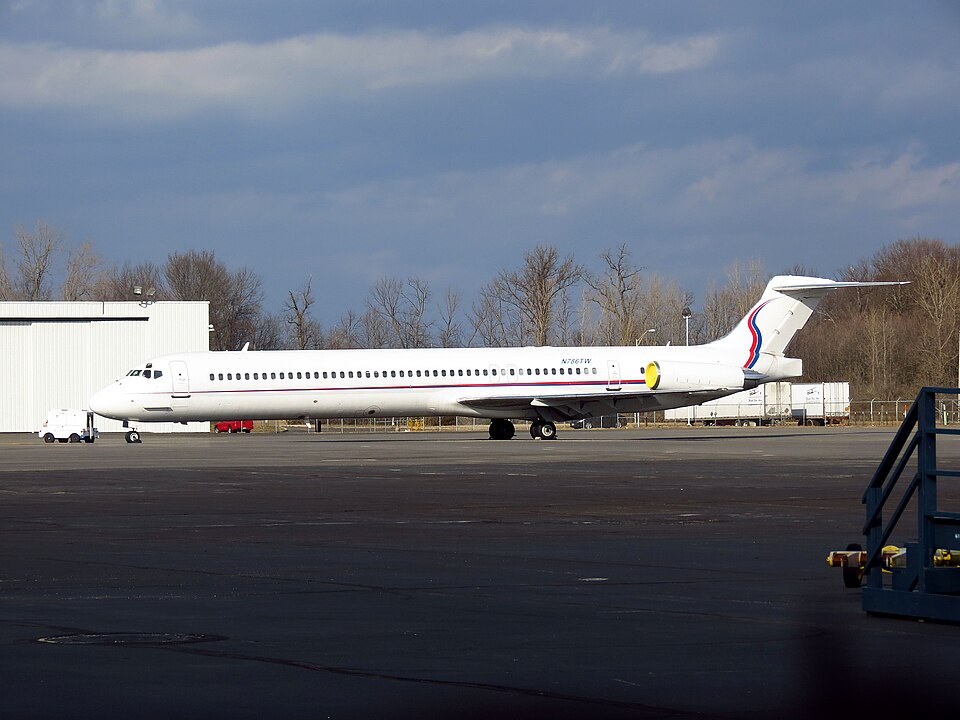
Accident Description
On the day of the accident, a McDonnell Douglas MD-83, registration N786TW, operated a charter flight for the University of Michigan Basketball team. During takeoff from runway 23L at Detroit-Willow Run Airport, Michigan, the flight crew decided to abort the takeoff. The aircraft failed to stop on the runway, overran the end, damaged approach lights, went through the perimeter fence, crossed Tyler Road, and came to rest on grassy terrain 345 meters past the runway end. The nose landing gear collapsed.
Flight Preparation
The flight crew prepared for takeoff using "Normal Thrust Takeoff" and calculated V-speeds based on a 10-knot headwind and a takeoff weight of 146,600 lbs. The calculated speeds were V1=139 knots, VR=142 knots, and V2=150 knots. However, the crew increased VR to 150 knots to allow for more control in the presence of windshear.
Takeoff Roll and Rejected Takeoff
At 14:51:56, approximately 3,000 feet down the runway at an airspeed of about 138 knots, the control column was pulled back slightly. The left elevator moved from -15° trailing edge down to -13°, while the right elevator remained at approximately -16°. At 14:52:01, a large control column input was made at 151 knots and 4,100 feet down the runway, moving the left elevator to near 15° trailing edge up. After 14:52:05, the right elevator moved to -13° trailing edge down but did not respond further. The airplane did not pitch up or rotate. The captain then decided to abort the takeoff. Maximum ground speed reached was 163 knots (173 knots airspeed). Brakes were applied at 14:52:08, spoilers deployed at 14:52:10, and thrust reversers between 14:52:13 and 14:52:15. The airplane could not stop on the 7,543-foot runway; ground speed was 100 knots when it departed the paved surface.
Probable Cause
The NTSB determined that the probable cause of this accident was the jammed condition of the airplane’s right elevator, which resulted from exposure to localized, dynamic wind while the airplane was parked and rendered the airplane unable to rotate during takeoff. Contributing to the accident were (1) the effect of a large structure on the gusting surface wind at the airplane’s parked location, which led to turbulent gust loads on the right elevator sufficient to jam it, even though the horizontal surface wind speed was below the certification design limit and maintenance inspection criteria for the airplane, and (2) the lack of a means to enable the flight crew to detect a jammed elevator during preflight checks for the Boeing MD-83 airplane. Contributing to the survivability of the accident was the captain’s timely and appropriate decision to reject the takeoff, the check airman’s disciplined adherence to standard operating procedures after the captain called for the rejected takeoff, and the dimensionally compliant runway safety area where the overrun occurred.