History of the Flight
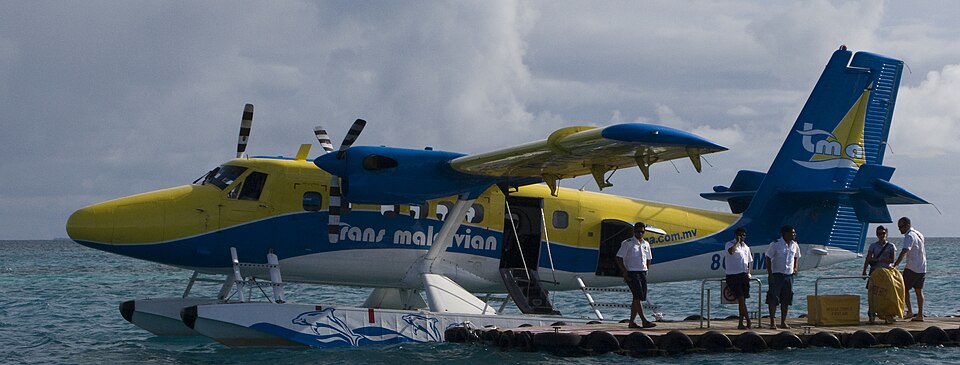
At approximately 0810 on 19 February 2001, a De Havilland DHC-6 Twin Otter operated by Trans Maldivian Airways was maneuvering on the water near the Floating Platform after landing in the lagoon adjacent to Sun Island Resort. The aircraft struck another Twin Otter (registration 8Q-TMH) that was parked against the floating platform. Neither aircraft carried passengers, and no crew injuries were reported. The accident was reported to the Civil Aviation Department at 0930 the same day.
Aircraft and Personnel Information
The accident aircraft, a DHC6-100 serial number 082 manufactured in Canada in 1968, held a valid Certificate of Airworthiness until 13 May 2001 and a Certificate of Maintenance Review until 6 May 2001. It had accumulated 25,331 total flight hours. The pilot in command, aged 27, held an Airline Transport Pilot Licence and had approximately 3,500 total flight hours, including 1,900 hours on type. The first officer, aged 54, also held an Airline Transport Pilot Licence with about 12,500 total hours, including 500 hours on type. Both pilots were appropriately rested and showed no evidence of incapacitation.
Meteorological Conditions
Weather at the time was overcast with visibility better than 10 kilometers and a light northerly breeze.
Damage to Aircraft
The accident aircraft (8Q-TMA) suffered substantial damage to the nose, front windscreens, and the upper forward area of the cockpit, along with minor damage to one float. The parked aircraft (8Q-TMH) sustained substantial damage to the port wingtip and aileron. After the collision, the accident aircraft came to rest with one float on the platform, and the wingtip of the parked aircraft protruded into its cockpit.
Investigation Findings
The investigation determined that the pilot had feathered the propellers while waiting on the water, a practice that was not standardized among pilots. Feathering reduces propeller thrust to zero, but the gas generator continues to produce jet thrust from the exhaust. In this case, the jet thrust exceeded the effect of the light wind, causing the aircraft to move upwind. When the pilot attempted to unfeather the engines, he moved the power levers aft too soon while the propellers were still at a forward thrust angle, resulting in a forward surge of thrust instead of reverse.
The analysis noted that the crew were appropriately licensed and qualified, and the aircraft was airworthy. The landing area was found suitable but not properly licensed, which was a regulatory breach but not considered a factor in the accident. The company had since taken action to prevent recurrence, including banning the practice of feathering propellers while waiting on water and recommending a review of standard operating practices.
Probable Cause
The accident was caused by an error on the part of the pilot in that he over-estimated the effect of the wind on the aircraft with the propellers feathered, and he attempted to apply reverse thrust too soon after taking action to unfeather the propellers.