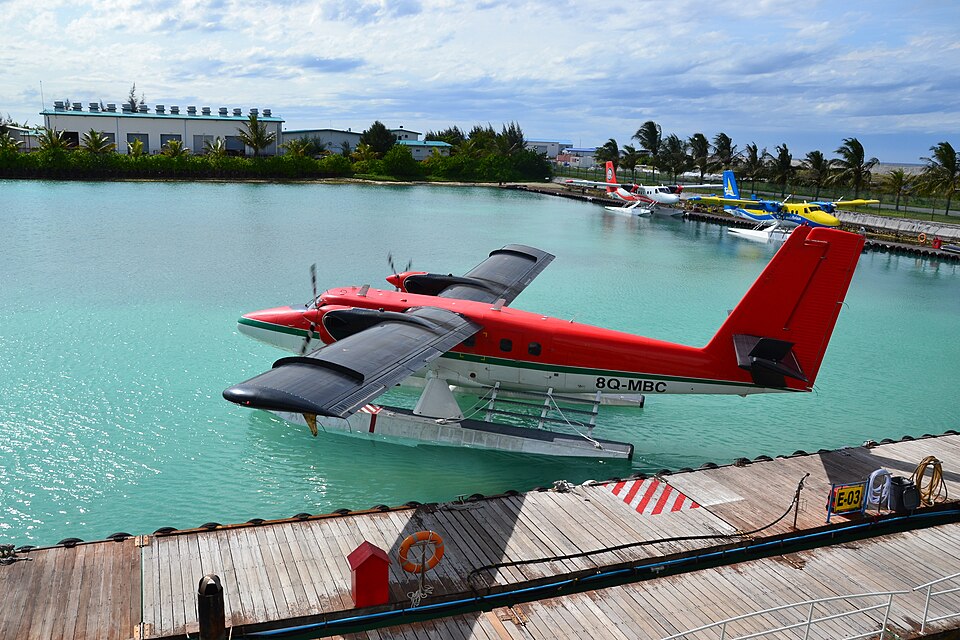
History of the Flight
On 24 February 2020, at 11:35 hours local time, a Viking Air (de Havilland Canada) DHC-6-300 aircraft, registration 8Q-MBC, operated by Trans Maldivian Airways Pvt. Ltd., was on a charter flight from Velana International Airport to Kuredhu Island Resort. The flight was conducted under Visual Flight Rules. Onboard were fifteen passengers, two pilots, and one cabin crew member.
The pilots reported for duty at 06:00 hours at the operator's base. Both pilots were on their first day back after a three-day rest period. It was the first time they had been paired together. No crew introductions or briefings were made prior to the flight.
Accident Sequence
During landing at the water aerodrome at Kuredhu Island Resort, the aircraft touched down on one of the designated but unmarked water runways. The water aerodrome was experiencing squally winds and rough seas under sunny conditions, typical of the north east monsoon season. After touchdown, the aircraft bounced. Following the bounce, the aircraft banked to the left, causing the left wingtip to contact the water. The aircraft then veered left, and the right wing abruptly dropped as the nose dug into the water. The pilot-in-command attempted to initiate a go-around after the bounce but was unsuccessful.
Injuries and Damage
All passengers and crew evacuated safely. As a direct consequence of the accident, two crew members and one passenger suffered minor injuries. The aircraft sustained substantial damage to the fuselage, wings, engines, and propellers. Both floats remained intact, and the aircraft remained upright. After the accident, the aircraft taxied to a mooring buoy using left engine power and assistance from a dinghy.
Aircraft and Crew Information
The aircraft was a Viking Air (de Havilland Canada) DHC-6-300, serial number 256, registered as 8Q-MBC in the Republic of Maldives. It was owned and operated by Trans Maldivian Airways Pvt. Ltd., holding Air Operator Certificate No. 005. The aircraft was equipped with two engines and propellers, though specific models were not detailed in the report.
The pilot-in-command and co-pilot were both on duty for the first time after a three-day rest period. Their previous duty history and qualifications were reviewed during the investigation but are not specified here.
Meteorological and Aerodrome Conditions
At the time of the accident, the water aerodrome at Kuredhu Island Resort was experiencing squally winds and rough seas. The conditions were sunny, which is common during the north east monsoon typical for that time of year. The water runways were designated but not marked.
Investigation
The accident was reported to the Accident Investigation Coordinating Committee (AICC) by the Maldives Civil Aviation Authority (MCAA) at 12:02 hours on the same day. An investigator from MCAA arrived at the accident scene at approximately 13:00 hours. Two additional investigators arrived at around 17:15 hours. The investigation involved gathering data, interviewing crew, passengers, and available witnesses. The aircraft wreckage was examined, and salvage operations were conducted.