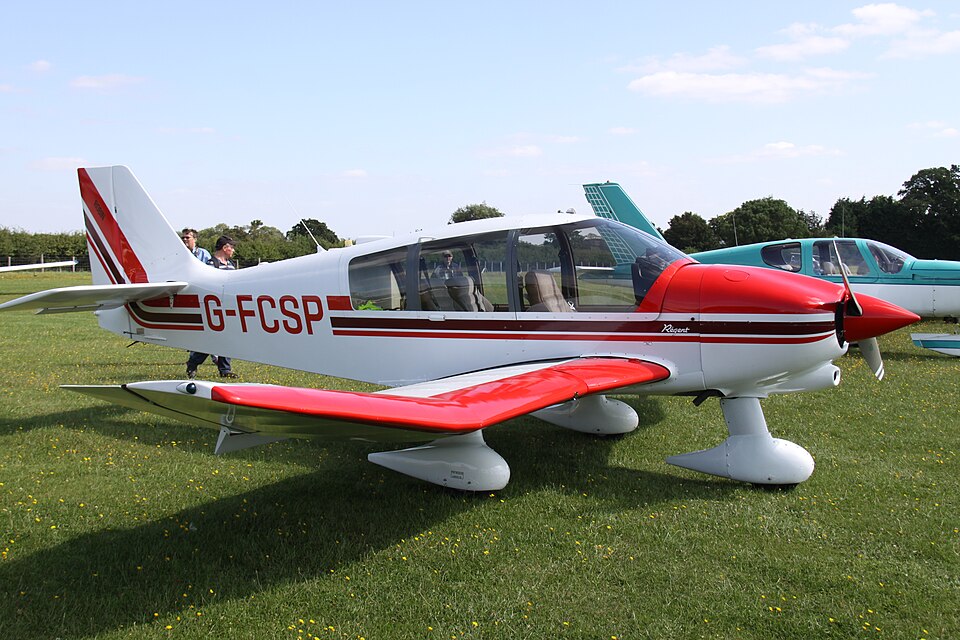
History of the Flight
The pilot departed Biggin Hill for the Isle of Bute to attend a commemorative event. He was keen to participate and reported being somewhat preoccupied. While crossing the mainland coast, he descended to 600 ft amsl to stay clear of cloud. Upon arrival at the Isle of Bute, he overflew the airfield and noted a slight southerly wind from the windsock. He established the aircraft in a teardrop turn onto final approach for Runway 27. The runway had a short grass surface, and recent rain had left it damp.
The pilot recalled that he may not have set the flaps for landing, attributing this to the limited time available during the teardrop turn to complete pre-landing checks. However, photographs taken after the accident showed the flaps in the landing position. He commented that although experienced on type, he seldom landed on short grass runways.
Landing and Damage
The approach was flown at 56 kt, which was slower than the normal approach speed of 65 kt. The aircraft touched down approximately 150 m beyond the beginning of the 480 m strip. It rolled along the remaining length of runway, ran through a fence, and crossed a ditch. The aircraft came to rest on its main landing gear and engine cowling, with the nose landing gear detached. The propeller and right wing were damaged. The pilot evacuated the aircraft without difficulty, and there was no fire.
After the accident, the pilot assessed the wind as from the south-east at 5 kt, which would have resulted in a slight tailwind on Runway 27.
Additional Information
According to the Aircraft Flight Manual, the landing distance required on a dry, smooth concrete runway under the conditions at the time would have been 451 m, with a landing ground roll of 201 m. The runway at Bute is 480 m long. The CAA's Safety Sense Leaflet 7c, 'Aeroplane Performance', suggests safety factors for performance calculations. For landing on short wet grass up to 20 cm long, a factor of 35% of landing distance is recommended, noting that very short grass may be slippery and distances could increase by up to 60%.
Applying the short wet grass factor would increase the landing roll to 271 m. Adding the suggested safety factor of 43% would bring the distance to 387 m, and a slight tailwind would further increase it.
The flight manual presented landing ground roll data under the heading 'landing ground roll (over 15 m barrier)', which the pilot noted might have caused confusion.
The pilot commented that his keenness and concern to reach the event had led him to fly when he was not as 'cool, calm, and collected' as he should have been.