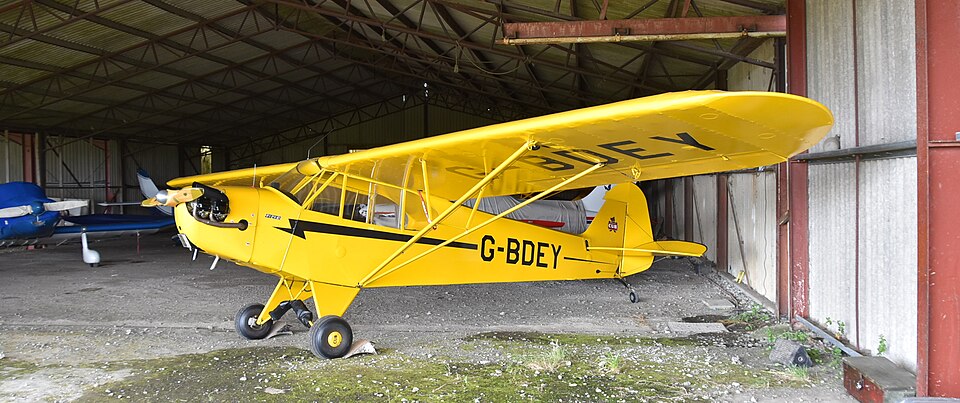
Incident
On 22 June 2001 at 1445 UTC, a Piper J3C-65 (registration G-BDEY) operating a training flight from Fenland Airfield near Spalding, Lincolnshire, collided with a Low Intensity Two Colour Approach Slope System (LITAS) installation while taxiing. The aircraft was being used for type conversion training with the owner, who was seated in the front. The flight had already completed 2 hours and 35 minutes of training, and the crew intended to perform two additional circuits from grass Runway 36/18 before departing to the aircraft's home base at Empingham.
Background
To position for takeoff, the aircraft taxied clear of the runway edge markers onto the runoff area and backtracked toward the threshold of Runway 36. The front-seat occupant (the aircraft owner) was short in stature and required an elevated seat cushion and back padding to reach the rudder pedals. This significantly reduced forward visibility for the instructor in the rear seat, creating an obscured arc of 30° to 40° either side of the aircraft centerline. The instructor therefore had to weave the nose from side to side during ground manoeuvring to see ahead.
Near the Runway 36 run-up area, a LITAS installation had been damaged in a previous taxi incident and partially removed. The remaining structure was a metal frame marked by an amber traffic cone approximately 4 feet high with a 2-foot base diameter. Despite the weaving technique, the aircraft struck this obstruction.
Damage and Recovery
The engine was shut down, and inspection revealed the framework had contacted the underside of the left landing gear, partially cracking the tension bar. The aircraft was some distance from the airfield facilities, so it was taxied slowly back for further inspection. Before reaching the parking area, the tension bar broke completely, causing the left landing gear to collapse. The aircraft was subsequently recovered by lifting the wing and walking it to the hangar.
The instructor noted that, in hindsight, the landing gear should have been secured before any movement was attempted. He also reported that runway marker boards had recently been repositioned at the request of CAA Aerodrome Standards officials, leaving the LITAS installation more exposed within the runoff area. Following this accident and previous occurrences, the airfield operator began relocating the LITAS to the edge of the runoff area.