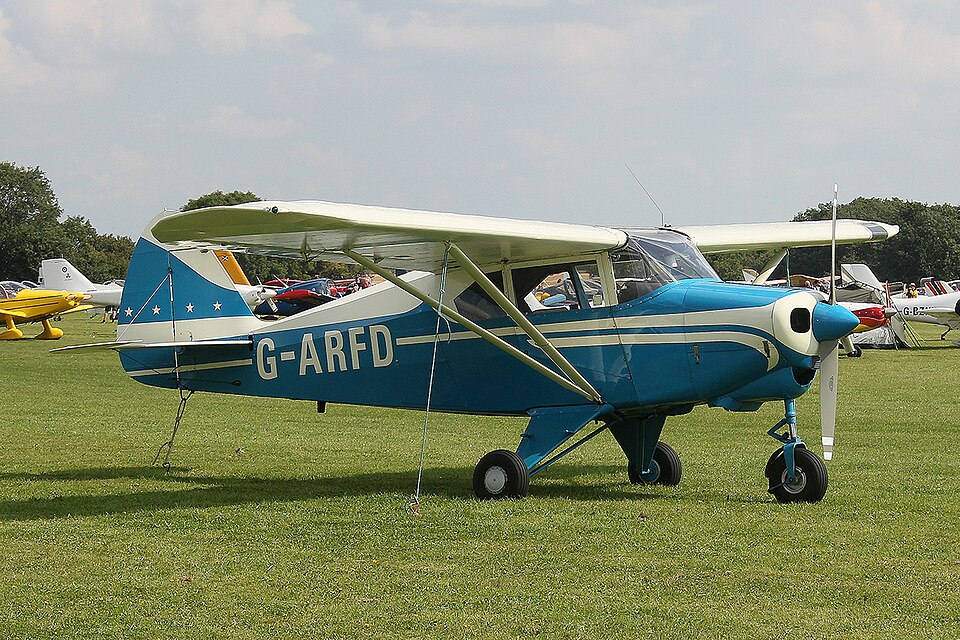
Accident
On 25 May 2013 at 1349 UTC, a Piper PA-22-160 Tri-Pacer, registration G-ARFD, overran the paved surface of Runway 08 during landing at Elstree Aerodrome, Hertfordshire. The aircraft had been returning from a 30-minute trial lesson with two passengers. The pilot conducted a normal approach at 65 kt with landing flap selected; wind was light and variable. The Landing Distance Available (LDA) for Runway 08 was 651 metres.
After touchdown in the normal area, the pilot sensed that the brakes had failed and realised the aircraft would not stop before the end of the paved surface. He reached for the lever underneath the instrument panel that applies the brakes. Initially, pulling the lever generated some retardation, but it progressively deteriorated. By the midpoint of the runway, the pilot radioed the ATC tower that he “had no brakes”. Further attempts using maximum strength with both hands produced some additional retardation, but insufficient to prevent overrunning the end of the runway. At a very slow speed, the aircraft ran onto grass, crossed a patch of long grass, and came to a halt in a nose-down attitude with the nosewheel in a small ditch. The propeller spinner was embedded in the far side of the ditch, but the nose gear did not collapse. The pilot radioed the tower that there were no injuries, shut down the engine, and he and his passengers exited normally. The pilot could smell fuel and saw some leaking from the cowling area.
Aircraft and Crew
The aircraft was a 1960 Piper PA-22-160 Tri-Pacer, serial number 22-7565, powered by one Lycoming O-320-B3B piston engine. The commander held a Commercial Pilot’s Licence, was 48 years old, and had 706 hours total flying experience, of which only 2 hours were on type. His last 90 days included 12 hours, and his last 28 days 10 hours.
Braking System
The original PA-22 aircraft was not equipped with differential toe brakes. Instead, it relied on a single hydraulic master cylinder operated by a handle under the instrument panel, which applies drum brakes on both wheels. G-ARFD was an unmodified Tri-Pacer and did not have any Supplemental Type Certificate (STC) modifications to improve the braking system, such as disc brakes.
Aftermath
During recovery, the braking system was found to be operational. The pilot attributed the overrun to “brake failure combined with downhill sloping runway”. However, the operator reported that the brakes were working during recovery, and it was not possible to establish the reason for the overrun.