History of the Flight
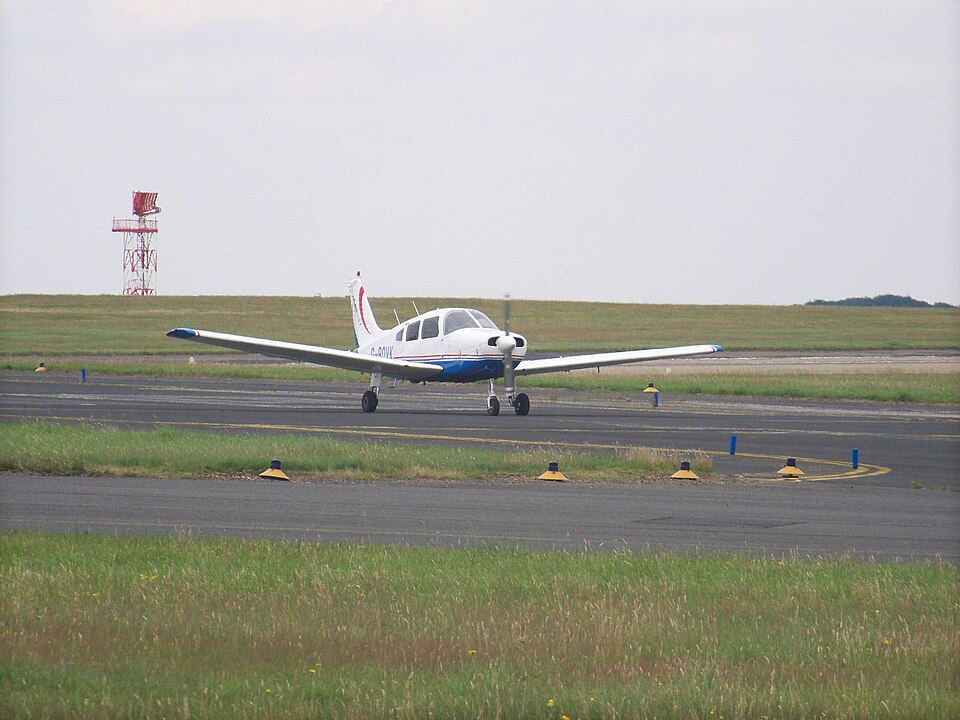
On 25 May 2013, at 1849 UTC, a Piper PA-28-161 Cherokee Warrior II, registration G-BOVK, departed Leeds Bradford Airport (LBA) for a private pleasure flight with one pilot and three passengers. The route included the Lake District and Blackpool before returning to LBA. The pilot, aged 35 with 93 total flying hours (23 on type), held a Private Pilot's Licence. Upon return, he was cleared to re-enter LBA controlled airspace and positioned for base leg on Runway 32.
While turning onto base leg, the engine suddenly lost power, hesitated, ran down to idle, and stopped. The pilot, over a built-up area at approximately 1,000 ft agl, decided against diagnosing the problem due to limited time and altitude. He focused on gliding clear and selecting a suitable field for a forced landing. After transmitting a MAYDAY call, he executed a successful engine-off landing in a field about 4 miles south of LBA.
During the landing roll, the aircraft passed through livestock electric fences, and at least two fence posts impacted the leading edges of both wings, causing dents. The pilot and passengers vacated the aircraft without injury.
Aircraft Fuel System
The Piper PA-28-161 fuel system comprises left and right wing tanks feeding an electric pump and an engine-driven pump to supply the carburettor. A three-position fuel selector valve allows manual control: rotating clockwise from off (rear) selects left tank (upward) and then right tank (forward). Fuel contents gauges are on the left side panel, to the right of the control yoke.
Post-incident examination revealed the left tank contained 15 imperial gallons; the right tank was empty. No fuel leakage was found.
Pilot's Comments
The pilot voluntarily provided an analysis. He had been using a navigation aid (tablet device) mounted on the control yoke as part of practice for a future long-distance navigation flight for CPL training. He was in the habit of marking his chart for fuel tank changeover, usually coinciding with a turn or waypoint. On this flight, he placed the chart aside and relied on the navaid. A minor change in a turning point due to isolated low cloud coincided with the planned tank switchover, causing him to forget the switch. Additionally, the navaid partly obscured the right tank contents gauge, so its decreasing level did not catch his attention during instrument scans. He elected to concentrate on the forced landing rather than attempt a tank switch and engine restart, given the built-up area and limited altitude.