Accident Details
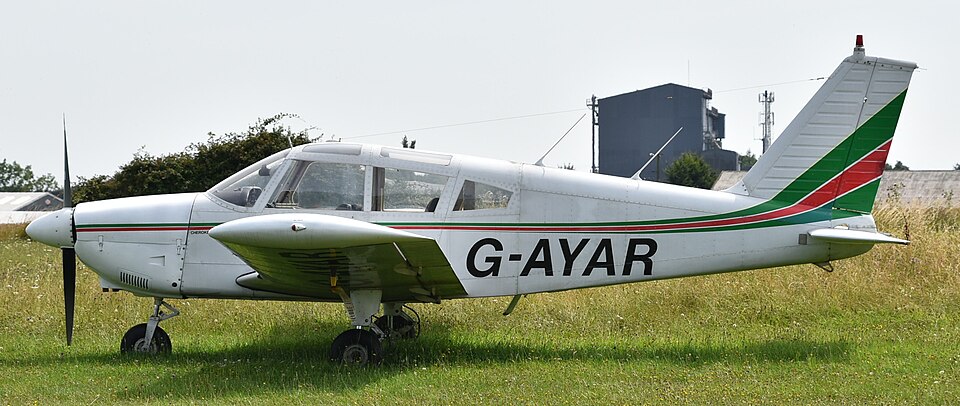
The accident involved a Piper PA-28-180 Cherokee, registration G-AYAR, manufactured in 1970. The aircraft was powered by a single Lycoming O-360-A4A piston engine. The flight was a private Visual Flight Rules (VFR) trip from Southend Airport to Exeter Airport. The pilot held a Private Pilot's Licence, was 23 years old, and had accumulated 106 total flying hours, with 73 hours on type. His recent flying experience included 13 hours in the last 90 days and 4 hours in the last 28 days.
Flight and Weather
The pilot obtained weather information from the internet, which indicated good visibility, a high scattered cloud base, and strong, blustery winds from the north-east. The transit to Exeter was uneventful with occasional turbulence. The 1320 hrs METAR for Exeter Airport reported surface wind from 030° at 18 knots, gusting 28 knots.
Landing Sequence
The aircraft was established on final approach for Runway 08 at approximately 70 knots indicated airspeed with full flap selected. The pilot rounded out normally, and the main wheels touched down. However, when the nosewheel contacted the runway, the aircraft bounced several times. During these bounces, the nose landing gear collapsed. The aircraft veered to the right, departed the runway, and came to rest on the grass. The pilot then isolated the fuel and electrical systems before exiting through the normal door.
Pilot's Assessment
The pilot considered that he had probably been a little fast on the approach, which led to a fast touchdown. As the aircraft bounced, he allowed a Pilot Induced Oscillation (PIO) to develop, which caused the damage to the nose landing gear. He felt he should have initiated a go-around when the aircraft first bounced.
Damage
The accident resulted in the nose landing gear being broken and damage to the propeller.