Aircraft and Pilot Information
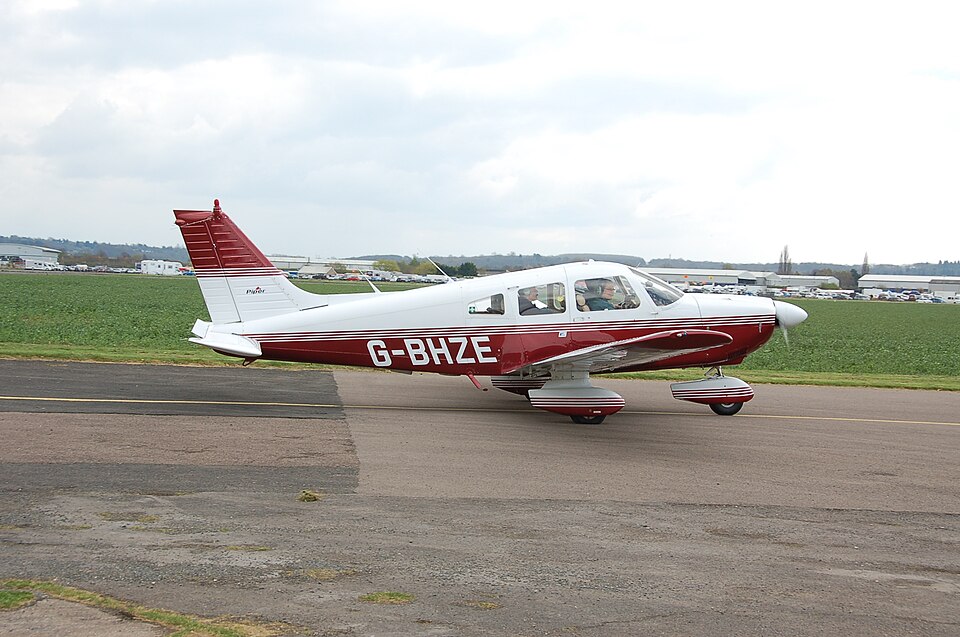
The aircraft involved was a Piper PA-28-181 Cherokee Archer II, registration G-BHZE, manufactured in 1978. It was powered by one Lycoming O-360-A4M piston engine. The pilot, aged 42, held a Private Pilot's Licence and had 188 hours total flying experience, with 166 hours on type. In the previous 90 days, he had flown 41 hours, and 14 hours in the last 28 days. The flight was a private, solo operation.
History of the Flight
The pilot was conducting circuits at White Waltham Airfield using Runway 11, a grass runway 930 meters long. Weather conditions were good with a light wind from approximately 110 degrees. After completing five or six touch-and-go landings, the aircraft bounced on touchdown during the final approach at approximately 70 KIAS with full flap. The aircraft then bounced four more times with increasing severity and increasing nose-down attitude. The pilot kept the throttle closed and applied back pressure on the yoke after each bounce, aiming to land on the main wheels. During the fourth touchdown, the nose landing gear leg sheared. On the fifth touchdown, the propeller and spinner struck the ground, causing an abrupt stop. The pilot reported the accident by radio, turned off the electrical systems, shut off the fuel cock, and exited the aircraft.
Eyewitness Account
An eyewitness positioned at the hold to Runway 11 reported that the approach appeared normal. Following the initial touchdown, the aircraft bounced approximately 3 to 4 feet into the air. The nose lowered, and the second touchdown was slightly nosewheel first, followed by another bounce of similar height. The nose attitude then lowered considerably, resulting in a significant nosewheel-first contact on the third touchdown, causing a bounce of 6 to 8 feet. After the fourth touchdown, which also involved a nosewheel-first contact, damage to the nose gear leg was observed. The fifth touchdown caused the damaged gear leg to dig into the ground.
Pilot's Assessment
The pilot could not recall with certainty the control inputs made after the initial bounce, but he was certain that he kept the throttle closed. He believed that he applied back pressure on the yoke after the first and subsequent bounces to recover. He had successfully recovered from bounced landings in the past using this technique. He assumed that the increasing severity of the bounces was due to the nosewheel contacting the runway before the main wheels on the second touchdown, which he attributed to insufficient back pressure on the yoke.
AAIB Comment
The Air Accidents Investigation Branch noted that different techniques are required depending on the severity of a bounce during landing. Small to moderate initial bounces may be recoverable with appropriate technique if sufficient runway is available. A good technique for a heavy bounce is to initiate a go-around.