History of the Flight
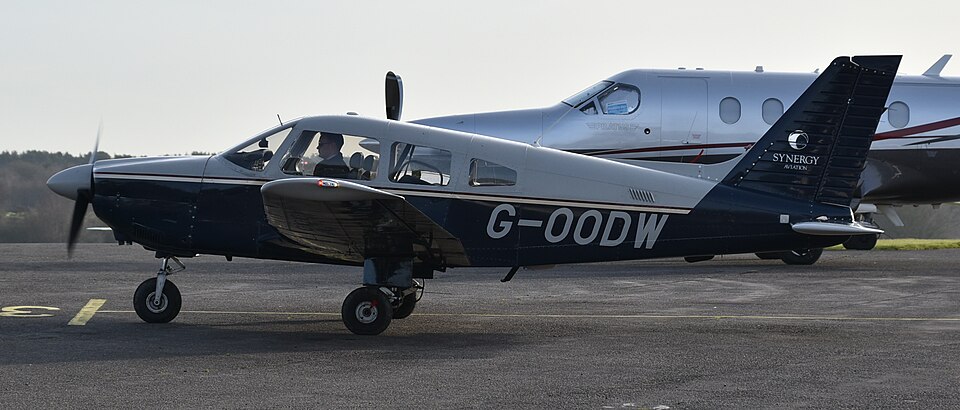
The pilot of a Piper PA-28-181 Cherokee Archer II, registration G-OODW, had flown from Fairoaks Airfield to Turweston Aerodrome. After landing, he left the aircraft parked and was met by friends. A local flying instructor approached the parked aircraft from the front left quarter to inspect its navigation equipment and did not recall seeing any damage to the left wing.
Upon returning, the pilot performed a pre-flight inspection, which included checking the fuel tank filler caps; for the left wing, this was done from the leading edge, and he did not observe any damage.
Taxi and Collision
The pilot performed his normal checks and taxied for departure from Runway 27. Weather conditions were good, with dry conditions, no precipitation, good visibility, and a gusty wind from the northwest. He backtracked Runway 27 and exited at Holding Point C onto the taxiway, which has a yellow centreline marking. Approximately 30 m from the holding point and 9.3 m east of the taxiway centreline, a red 'BEWARE – Very low flying aircraft' warning sign is located on the side of the taxiway. The sign is intended to be visible to vehicle drivers using the adjacent access road.
The pilot manoeuvred the aircraft to the left (east) of the centreline to ensure enough room to turn right back to the holding point to carry out a power check. During the turn, he felt a 'small bump' as the left wing contacted the warning sign and passed over it. From his cockpit position, he could only see a small dent in the left wing but did not connect it with the bump. Having performed the power check, the pilot took off and returned to Fairoaks.
Damage Discovery and Discussion
After landing at Fairoaks, the pilot discovered that the leading edge of the left wing was dented and torn. The pilot had not been aware of the full extent of the damage, which was not visible from the cockpit, before departing from Turweston. He concluded that he had not seen the warning sign due to its end-on aspect when he taxied off the runway and possibly because he was looking to the right, into the turn. On reflection, having felt a bump and seen a dent, he considered it would have been beneficial to have shut down the aircraft and checked it before departing.
The warning sign was not subject to a taxiway sign requirement but was erected to warn vehicle drivers on the adjacent access road that they may hear or see low flying aircraft approaching or departing from the runway. Civil Aviation Publication (CAP) 168, Licensing of Aerodromes, sets out the requirements for taxiway signs. Had the sign been a requirement, it would have had to be 12.5 m from the taxiway centreline, as opposed to 9.3 m as measured, and no higher than 0.36 m. The operator has carried out a review of the location of the warning sign and has elected to move it further away from the taxiway.