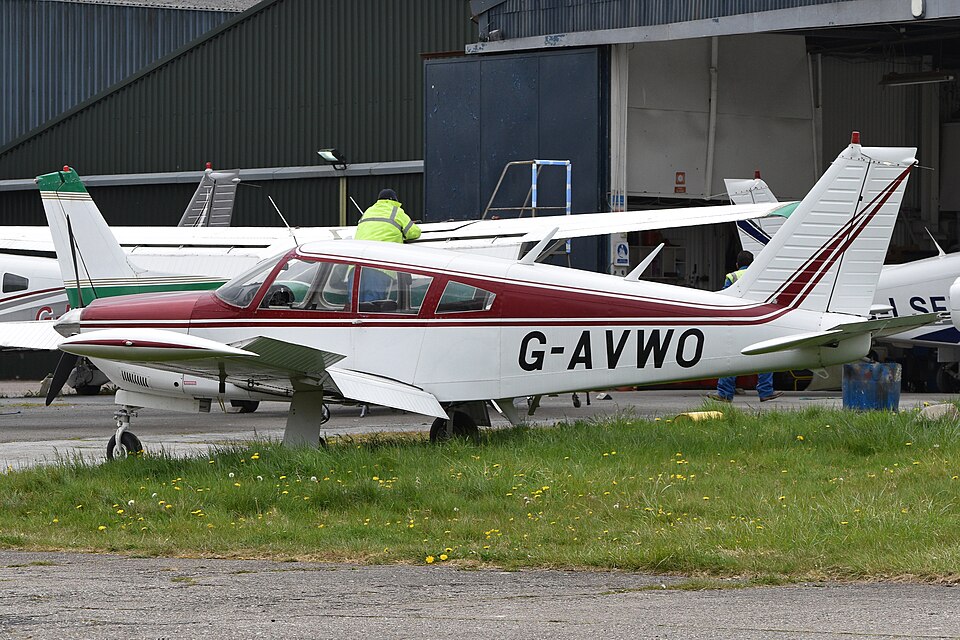
History of the Flight
On 10 August 2011 at 1750 UTC, a Piper PA-28R-180 Cherokee Arrow, registration G-AVWO, was on a private flight operating from Biggin Hill Airport, Kent. The pilot, the sole occupant, joined the circuit and extended the landing gear on the downwind leg. The three green 'down and locked' lights on the landing gear position indicator panel illuminated, and during pre-landing checks the pilot confirmed that all three landing gears were down and locked.
On touchdown, the three green lights remained illuminated, but immediately after the aircraft touched down, the left wing began to drop. The pilot observed that the landing gear 'in transit' light had now illuminated. As the aircraft's speed decayed rapidly, the pilot raised the left wing using aileron inputs while shutting down the engine and electrical systems. As the speed decayed, the left wing made contact with the ground, and the aircraft came to a halt on the runway. The pilot was uninjured and was able to leave the aircraft through the normal exit.
Investigation
The PA-28R-180 is fitted with three hydraulically actuated retractable landing gears, each with a mechanical downlock. The downlock consists of a pivoting hook attached to the upper drag link which rotates as the landing gear extends to engage a lock-pin on the lower drag link. When the downlock hook begins to engage the lock-pin, it actuates a limit switch on the lower drag link, illuminating the green 'down and locked' light. When all three limit switches are made, the landing gear 'in transit' light is extinguished and the hydraulic pump stops.
Examination of the main landing gear limit switches confirmed that they were correctly rigged. A test of the landing gear extension and retraction system appeared to operate normally, with all three downlocks engaged when the gear was extended. A detailed examination of the left main landing gear actuator identified a small hydraulic leak from between the actuator piston and the seal when the piston was in the extended position. The position of the leak corresponded to an area of wear on the chrome plating of the actuator piston.
Further tests revealed that when the left main landing gear was extended against a load, it would extend sufficiently to allow the downlock hook to actuate the landing gear limit switch, but the downlock hook would not fully engage on the downlock pin. Examination of the approved maintenance programme for the aircraft confirmed that there is no requirement for the routine removal of the landing gear actuator for overhaul. The aircraft records showed no evidence that the main landing gear actuators had been removed for overhaul.
Conclusion
The wear on the left main landing gear actuator piston prevented the left main landing gear from extending fully against flight loads. The downlock hook did not fully engage the downlock pin, despite providing an indication to the pilot that the gear had extended normally. On landing, the forces on the left landing gear caused the partially engaged downlock hook to disengage from the downlock pin, allowing the left main landing gear to collapse.