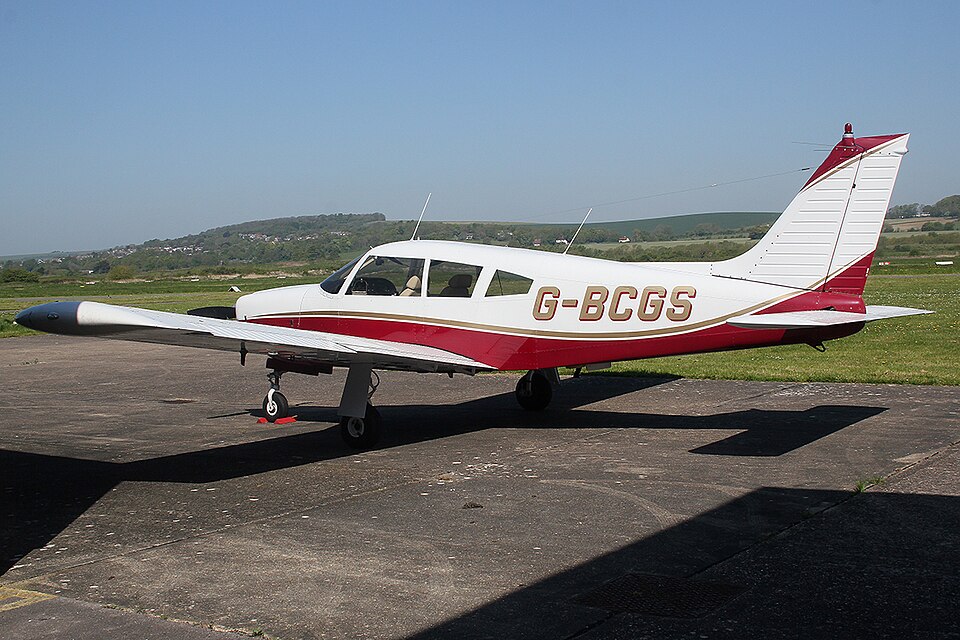
Synopsis
On 19 August 2006, a Piper PA-28R-200-2 Cherokee Arrow II, registration G-BCGS, overran the end of Runway 28 at Little Gransden Airfield, Cambridgeshire, during a private landing. The aircraft sustained damage to the right main landing gear, right wing, and right stabilator. The three occupants were uninjured.
History of the Flight
The aircraft departed Compton Abbas, Dorset, for a one-hour flight to its home base at Little Gransden. The pilot, a 54-year-old holder of a Private Pilot's Licence with 455 hours total (202 on type), joined the circuit and estimated the surface wind from 200° at 10 knots from the windsock, favouring a landing on Runway 28. Because of a turbulent crosswind, he chose to approach at a higher speed than normal and land with an intermediate flap setting (two stages of flap). The airfield's radio was unattended, which was not unusual when no training was taking place, so he could not obtain additional weather or runway information. He was unaware that recent heavy showers had left the grass runway very wet.
The pilot had obtained a Terminal Area Forecast for Cambridge Aerodrome before the flight, which predicted showers, but upon arriving overhead the airfield the sky was broken cloud and there was no indication of recent rain.
Landing Performance
On final approach, the pilot maintained a slightly higher airspeed for better control in the turbulent crosswind. He reported that the intermediate flap setting and higher speed caused the aircraft to float; it touched down on the centre line about one third of the way down the runway at 85 mph, approximately 15 mph faster than normal. Applying toe brakes had little effect, and the aircraft skidded on the wet surface. Brief applications of the parking brake achieved some success, but the pilot realised he could not stop within the remaining runway distance. Deciding against a go-around due to low speed, he initiated a gentle left turn to avoid rough ground beyond the runway end. The aircraft passed the runway end markings, continued turning left about 90°, and the right main landing gear collapsed. The aircraft came to rest about two metres beyond the runway end.
The calculated landing weight was 2,548 lbs. The aircraft's Flight Manual indicated an unfactored Landing Distance Required (LDR) of 411 metres on a dry tarmac runway with full flap. The CAA's Safety Sense Leaflet 7B recommends increasing LDR by a factor of 1.3 for wet grass, giving an amended LDR of 534 metres. Applying the Public Transport factor of 1.43 further increases LDR to 764 metres, though the leaflet notes the aircraft should be able to land without that factor. The published Landing Distance Available on Runway 28 at Little Gransden is 570 metres.
Pilot's Observations
The pilot concluded that the accident resulted from high workload during the turbulent final approach and late recognition of the combination of crosswind, high approach speed, wet surface, and lack of braking action. With touchdown about one third of the way down the runway at 15 mph faster than normal on wet grass, he noted there was little possibility of stopping within the remaining runway.
The CAA's General Aviation Safety Sense Leaflet 1C states: "A good landing is a result of a good approach. If your approach is bad, make an early decision and go-around. Don't try to scrape in. ... to touch down at the right speed, close to the runway threshold, unless the field length allows otherwise. ... Go-around if not solidly 'on' in the first third of the runway, or the first quarter if the runway is wet grass."