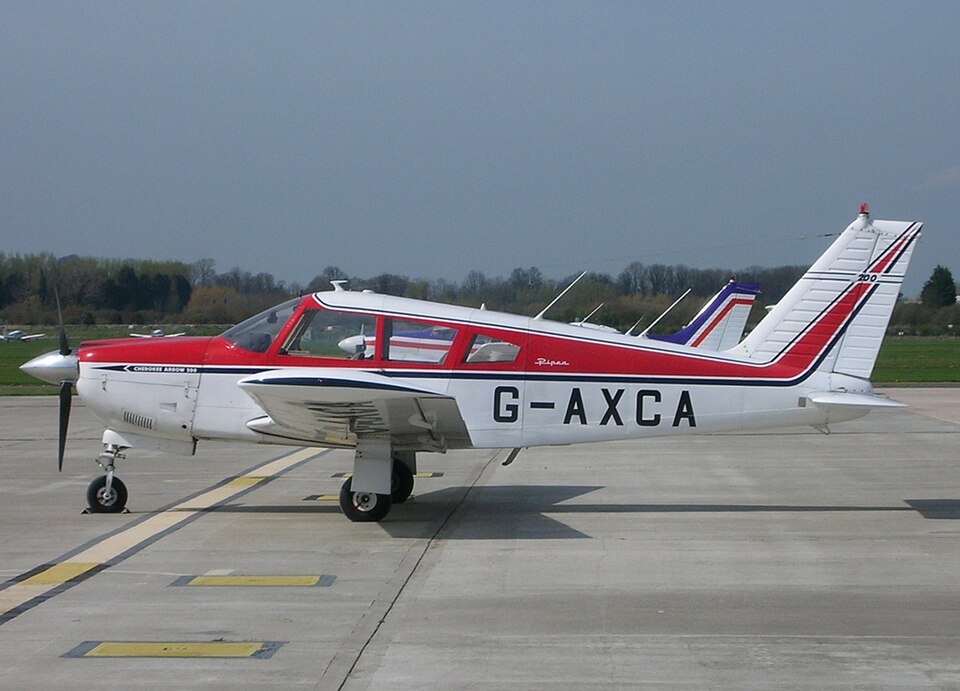
Accident Summary
On 4 October 2008 at 1215 UTC, a Piper PA-28R-200 Cherokee Arrow II, registration G-AXCA, experienced a collapse of its nose landing gear during landing at North Weald Airfield, Essex. The aircraft was on a private flight from Southend Airport with only the pilot on board. The pilot, aged 43, held a Private Pilot's Licence and had 649 hours total flying experience, including 178 hours on type. He reported no injuries, and the aircraft sustained damage to the nose leg, cowling, and propeller.
Flight History
The pilot reported that the weather was fine with an 18 kt wind from the southwest. He joined the circuit on the downwind leg and performed standard landing checks, including lowering the landing gear and confirming three green lights indicating the gear was down and locked. He experienced turbulence throughout the flight, which became severe on the base leg, causing him to hit his head on the aircraft roof. On final approach, he executed what he described as "an exceptionally good landing" on the main gear, maintaining a nose-up attitude with power and aft elevator. Shortly after the nosewheel contacted the runway, the nose landing gear collapsed, bringing the propeller and cowling into contact with the ground and rapidly slowing the aircraft. The pilot shut down and exited normally. When the nose of the aircraft was lifted during recovery, the nose gear leg extended without assistance.
Engineering Examination
The aircraft was transported to a local repair agency for examination. The repair agency reported that no failure could be identified in the landing gear or its retraction/extension system. A small amount of hydraulic fluid was found bypassing the hydraulic piston that actuates the gear, which may have affected the time for gear extension but should not have prevented locking. The piston was replaced as a precaution. The three green landing gear indication lights were confirmed operational, though it was not identified whether these or the warning lights functioned correctly through a full cycle.
Nose Gear Description
The nose gear leg is hydraulically moved by a piston attached to an over-centre hinge. When fully extended, the hinge prevents retraction until the piston is operated backward. A downlock hook retains the gear in the down and locked position. A drag strut braces the leg, preventing collapse backward when weight is applied. A squat switch isolates the hydraulic pump until the main gear is fully extended. In the cockpit, three green lights indicate when the gear down limit microswitches are made. An amber gear-in-transit light and a red gear-up warning light illuminate when manifold pressure drops below 14 in Hg and the gear is not down and locked, accompanied by a configuration warning horn.
Discussion
The pilot reported observing three green lights when extending the gear on downwind but could not be certain they remained illuminated on final. The down position microswitches, if correctly rigged, should illuminate the green lights only when the gear is down and locked. The failsafe design of the nose gear should prevent unlocking prior to a retraction command. The pilot reported no gear unsafe warnings before landing. Given the lack of a confirmed failure and the mechanical features preventing collapse after locking, it is probable that the nose gear was not fully locked in the down position before touchdown. This may have been related to the minor hydraulic piston fault, though severe turbulence cannot be ruled out as a contributory factor. It is also conceivable that the nose gear down limit microswitch was out of alignment, resulting in contact before full extension. However, the repair agency did not find evidence of microswitch misalignment.