History of the Flight
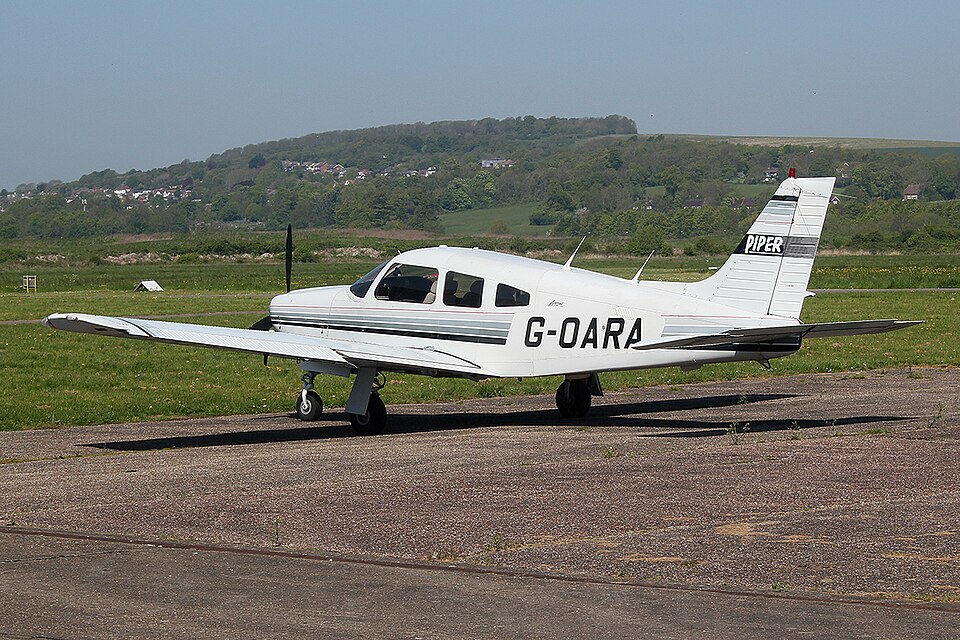
On 16 February 2001 at 0910 UTC, a Piper PA-28R-201 (registration G-OARA) operated by a flying school was conducting a training flight at Cranfield Airport, Bedfordshire. The aircraft was crewed by a flying instructor and a student, both of whom were uninjured. The flight was focused on circuit flying, with Runway 04 in use and a right-hand circuit established.
Weather conditions included a surface wind from 320° at 9 knots, visibility of 3,000 metres in haze, a few clouds at 1,500 feet, temperature +5°C, and QNH 1032 hPa. After the student completed a normal circuit and landing, the instructor requested a 'high glide' circuit. During the downwind leg at 1,300 feet above ground level, the student had difficulty assessing when to close the throttle for the glide approach. The student did not complete pre-landing checks, and the instructor made the downwind radio call. On the glide approach, the instructor believed the aircraft was too low and applied power to re-establish the correct approach path before reducing power to flight idle. The aircraft was cleared for a touch-and-go and landing flap was selected. The aircraft landed with its landing gear still retracted.
Post-Landing Events
After the aircraft came to a halt, the instructor made the aircraft safe and both pilots vacated without assistance. Airfield rescue and fire fighting services arrived promptly. The tower controller had noticed the undercarriage was not extended on short finals and transmitted a call to check '3 greens', which received no response. She then instructed a go-around due to no undercarriage, but the flight crew did not hear this transmission.
Undercarriage Warning System
The aircraft was fitted with an undercarriage warning system that activates a warning horn and a red 'WARNING GEAR UNSAFE' light under specific conditions: when gear is up and power is reduced below approximately 14 inches of manifold pressure; when flaps are extended beyond the approach position (10°) and landing gear is not down and locked; or when the gear selector switch is UP while on the ground and the throttle is retarded.
After the accident, the aircraft was placed on jacks at Cranfield, and retraction tests were completed satisfactorily. However, the undercarriage warning horn did not activate when the gear was UP, flaps set to LAND, and throttle retarded below 14 inches of manifold pressure. The aircraft was partially dismantled and transported to the company maintenance centre at Elstree Aerodrome. Further retraction tests after repair and maintenance found that the warning horn operated correctly. An air test confirmed the aircraft was serviceable.
The operator also uses other Piper aircraft of this type equipped with an automatic gear lowering system, which extends the gear even if the selector is UP at airspeeds below approximately 105 mph with the engine throttled back. G-OARA was not fitted with this system, as stated in the owner's handbook.