Aircraft and Crew
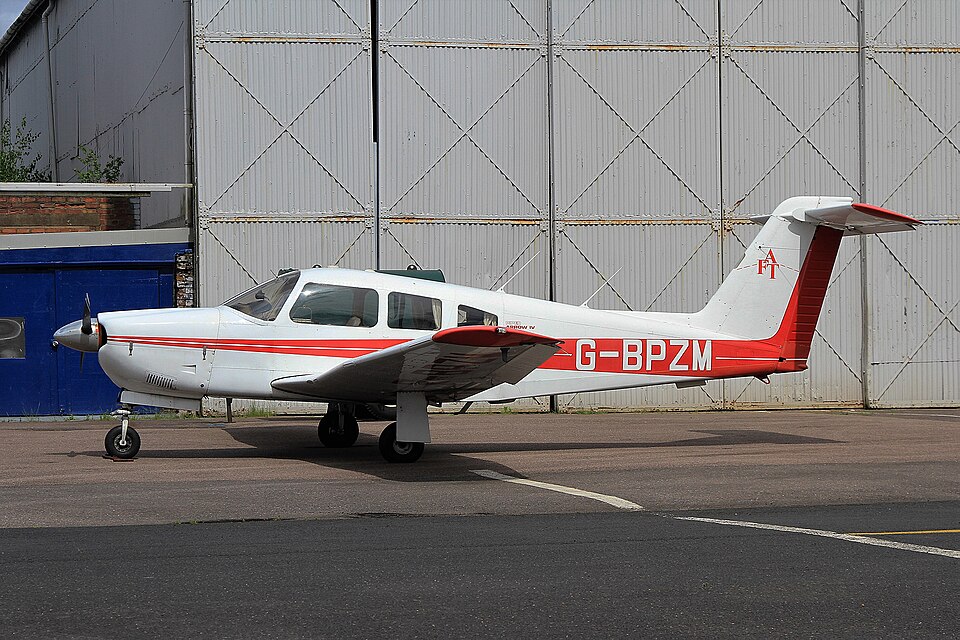
The aircraft involved was a Piper PA-28RT-201 Cherokee Arrow IV, registration G-BPZM, manufactured in 1979. It was powered by one Lycoming IO-360-C1C6 piston engine. The flight was conducted under a training category, with two persons on board: a student and an instructor. The commander, aged 65, held an Airline Transport Pilot’s Licence and had 14,600 total flying hours, including 300 hours on type. In the last 90 days he had flown 80 hours, and 60 hours in the last 28 days.
Flight Description
The flight was part of an Instrument Rating (IR) course. It was the student’s first flight in a PA-28R Cherokee Arrow, having previously completed a multi-engine conversion course in a BE-76 Duchess. The PA-28 was being used solely for specific instrument training, with no intention of converting the student to the type. During the ILS approach, only two flap selections were made, both by the instructor.
Landing and Incident
The student landed the aircraft satisfactorily. However, during the landing roll, the instructor heard a loud bang and the aircraft swerved towards the right side of the runway. Both occupants were uninjured and exited the aircraft without difficulty.
Post-Flight Discovery
While completing the shutdown checks, the instructor noticed that the landing gear selector lever was in the ‘UP’ position. The source notes that although the landing gear selector is located in a similar position in both the Cherokee Arrow and Duchess cockpits, the flap selector positions differ. In his haste to retract the flaps, the student had inadvertently retracted the landing gear.
Technical Context
The source states that inadvertent selection of the landing gear on the ground should be prevented by an electrical circuit signalled by a microswitch on the left main landing gear. However, as the landing gear was selected shortly after touchdown, it is likely the oleo may not have been sufficiently compressed to operate the microswitch, thereby allowing the gear to retract.
Damage
The propeller was destroyed and the engine shock-loaded. Skin damage occurred on the right wing lower surface, and the engine cowling underside was damaged.