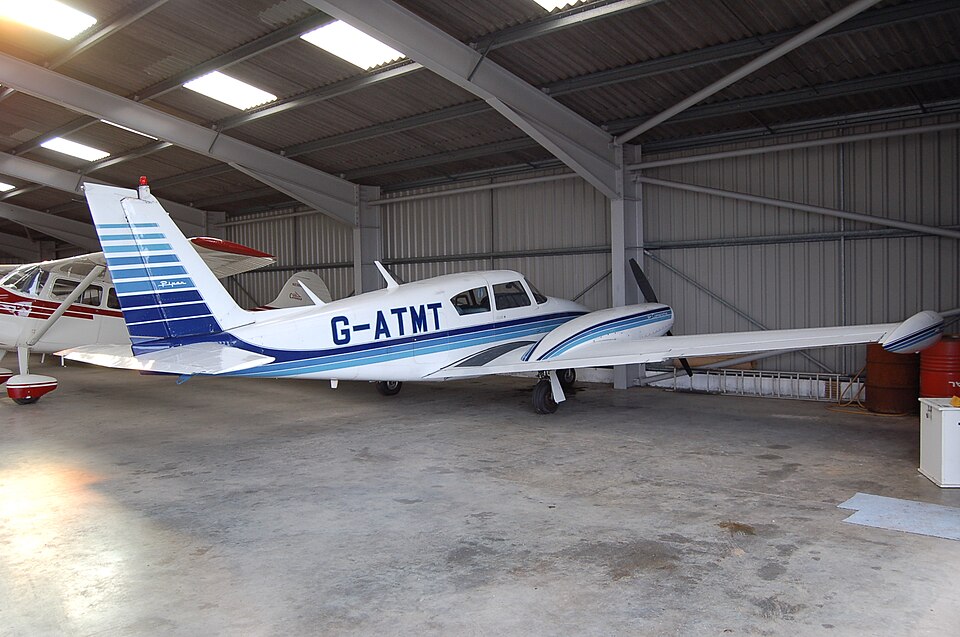
History of the Flight
On 14 August 2011, a privately operated Piper PA-30 Twin Comanche (registration G-ATMT) departed Alderney for Maypole Airfield in Kent. The aircraft carried one pilot and three passengers with 470 lb of Avgas, a takeoff weight of 3,484 lb, and a centre of gravity near the middle of the allowable range. The pilot planned to attend an event at Maypole before returning to the aircraft's home base.
Before departure, the pilot obtained weather forecasts for several airports, including Southampton, where the wind was forecast to be westerly at 8 kt. Weather across southern England was fine, with high cloud and good visibility. During the flight, the pilot briefly selected wingtip tank fuel but recalled that a significant quantity remained at landing.
Approach and Landing
On arrival, the pilot contacted the air/ground radio operator and was told Runway 20 (grass, 560 m long, with clearways giving 700 m maximum) was in use. The airfield website noted clearways at both ends, though these were not usable in winter. Runway 02 sloped uphill, but the slope had not been measured.
The pilot initially joined the circuit for Runway 20. However, after seeing another aircraft approach Runway 02, he left the circuit and rejoined for Runway 02. He normally flew final approach with full flap at 95 KIAS, reducing to 80 KIAS just before touchdown. He monitored airspeed but stated he did not fixate on the indicator. After the accident, he could not recall windsock indications, describing the wind as variable with "a lot of sink" on final, prompting him to apply "a lot of power." Touchdown was described as "quite firm," and the aircraft yawed significantly, which he countered with rudder and differential power. The landing run was short. An eyewitness reported that the aircraft fell suddenly just before touchdown.
Damage and Inspection
After being moved clear of the runway, the pilot observed a deflated left main landing gear tyre and "definite lines" on the wing skin. Subsequent engineering inspection revealed that the left wing main and rear spars were distorted, and the left main landing gear had over-travelled.
Performance Considerations
The landing weight was calculated at approximately 3,300 lb. According to the aircraft flight manual, the approach speed at that weight was 76 KIAS, though turbulence could dictate higher speeds. The manual's landing distance table, adjusted for dry grass (10% factor), gave a minimum required landing distance of 972 m—including the manual's 100/70 safety factor. Without that factor, the actual landing distance on grass was 618 m. The runway length, including clearway, was 700 m. The pilot stated he felt no pressure to execute a slow approach.
Meteorological Conditions
European Low Level Spot Wind Charts indicated the wind at 2,000 ft near Maypole was westerly at 10–15 kt, suggesting a surface wind of west-south-westerly at 7–12 kt. METARs from Manston Airport (7 nm east) showed winds variable between 200° and 320° at 7–8 kt.
Reporting and Safety Action
The accident was reported to the AAIB by a third party in February 2012; the pilot did not consider the damage reportable. In response, the operators of Maypole Airfield stated they would revise their website to correctly define the clearway.