History of the Flight
The aircraft departed from Boscombe Down, Wiltshire, on 30 May 2008 at 0915 UTC. During the climb, the crew noticed a burning smell. Flames appeared from the overhead panel and smoke emanated from the circuit breaker for the air recirculation fans. The commander found the circuit breaker stuck in the closed position and turned off all non-essential electrics, keeping radio, transponder, and navigation equipment to avoid entering Danger Areas. The aircraft returned to Boscombe Down, with the co-pilot using a BCF fire extinguisher, though the fire continued to smoulder. The aircraft landed safely with fire crew in attendance. The three occupants reported no ill effects or injuries but were taken to a local medical centre as a precaution.
Aircraft Information
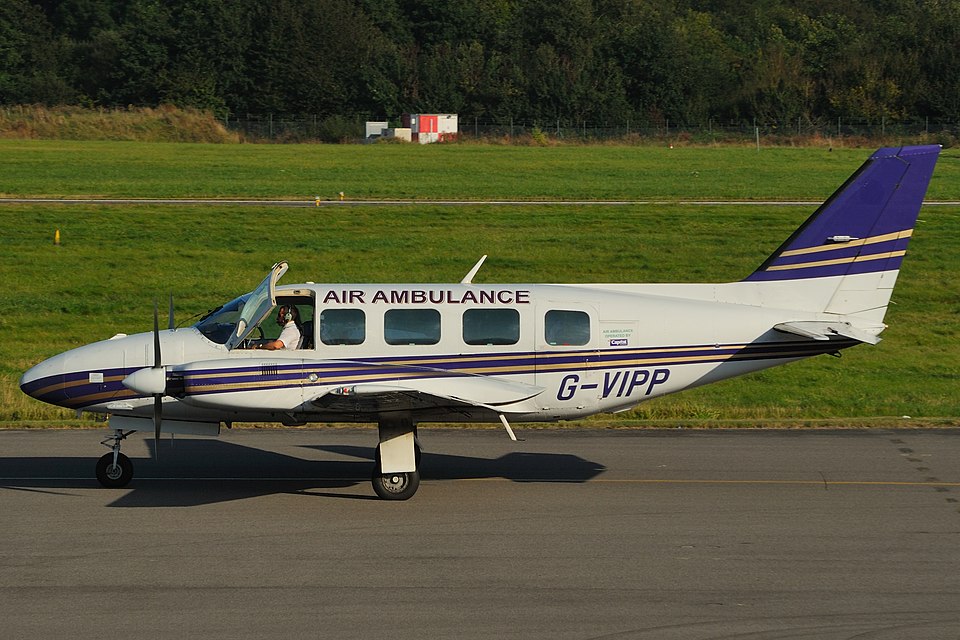
G-VIPP was a Piper PA-31-350 Navajo Chieftain, manufactured in 1979, with two Lycoming TIO-540-J2BD piston engines. It was operated as a commercial air transport passenger flight. The aircraft had two air recirculation blower fans in the lower fuselage forward of the main spar. The fans were controlled by a high/low switch in the overhead panel and a single 10A circuit breaker in the switch panel. Service Bulletin (SB) 704, introduced in 1982 to address fan motor winding problems and circuit breaker failure to trip, was not applicable to this aircraft.
Engineering Investigation
Examination revealed that the right recirculation fan had seized. The impeller had detached from the central boss due to a material failure in the fan back plate. The 10A circuit breaker showed significant heat damage and could operate mechanically but remained in the open circuit electrical state. The circuit breaker was found in the open circuit state, probably from heat effects. Internal inspection revealed significant heat damage and slight corrosion, but firm conclusions on its serviceability at the time could not be made. The insulation on two of three wires in the power feed cable had severe heat damage. Tests on an undamaged wire suggested the circuit was subjected to at least 40A, well above the 10A rating, for a significant period. A 10A breaker should trip in under 5 seconds at 400% load.
Other Circuit Breaker Failures
After the incident, the operator found an open-circuit landing gear circuit breaker on the same panel, with similar internal corrosion. The proximity to the DV window may have contributed to corrosion, and a program of circuit breaker replacement was considered. CAA Mandatory Occurrence Report data showed only three similar occurrences since January 2002, though several arcing faults that failed to trip had been noted worldwide.
Operator's Safety Actions
The operator embodied SB 704 (cabin fan fuse installation) on the aircraft, added a check for abnormal noise during recirculating fan functional checks, and introduced a circuit breaker functional check every 600 flying hours or 12 calendar months.