Incident
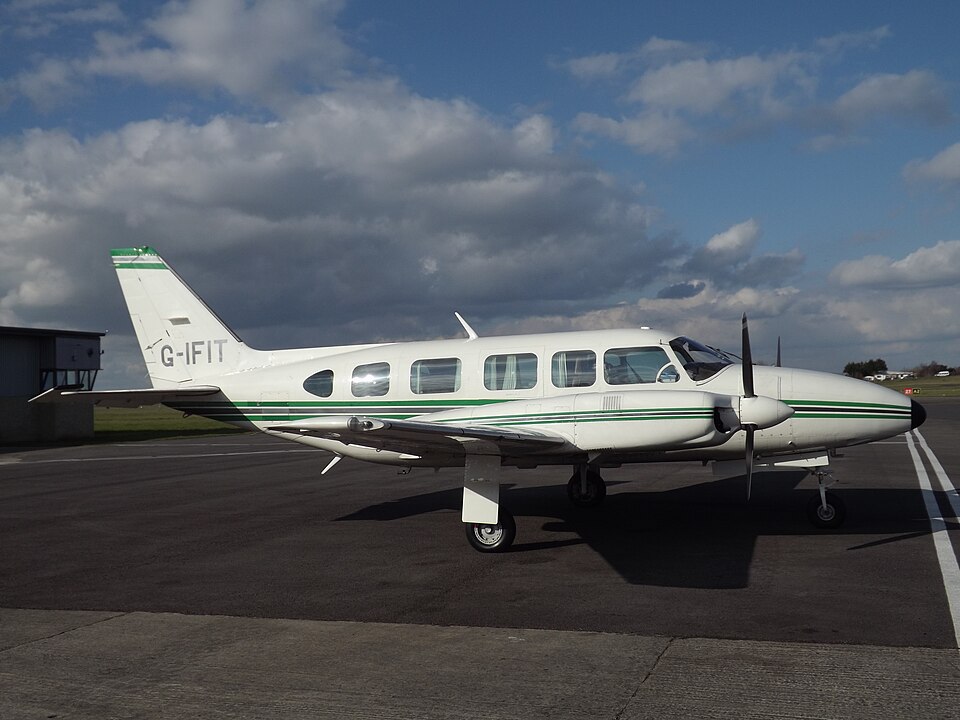
On 6 February 2004 at 1255 UTC, a Piper PA-31-350 Navajo Chieftan, registration G-IFIT, was taxiing to parking at Cardiff Airport. As the aircraft approached the ramp, a marshaller positioned between two parked Shorts 360 aircraft signaled the commander to pass to the left, execute a 180° turn, and park between and parallel to the Shorts 360s, facing the same direction.
During the taxi between the two parked aircraft, the commander lost sight of the marshaller. He then asked the occupant of the right cockpit seat to monitor the right wing tip for obstacle clearance and began a left 180° turn. Shortly after initiating the turn, both crew members felt a thud. The commander halted the aircraft as the marshaller reappeared and signaled to stop. The engines were shut down, and both crew members exited the aircraft uninjured.
The fin of the PA-31 struck the wing of one of the Shorts 360s. This resulted in damage to the top of the rudder and fin of the PA-31 and to the underside of the right wing of the Shorts 360.
Aircraft Information
The aircraft involved was a Piper PA-31-350 Navajo Chieftan, manufactured in 1980. It was equipped with two TIO-540-J2BD piston engines. The flight was a training flight with two crew members and no passengers.
Personnel
The commander held a Commercial Pilot's Licence and was 39 years old. He had accumulated 1,230 hours of flying experience, of which 396 hours were on the accident aircraft type. In the last 90 days he had flown 26 hours, and in the last 28 days, 18 hours.
Cause
In his report, the commander attributed the accident to his failure to stop soon enough after losing sight of the marshaller.