Aircraft and Flight Details
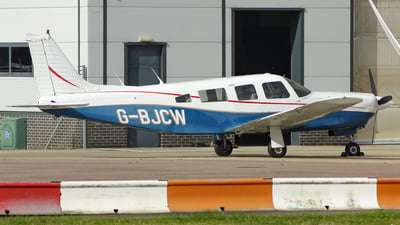
The aircraft involved was a Piper PA-32R-301 Saratoga SP, registration G-BJCW, manufactured in 1981. It was powered by a single Lycoming IO-540-K1G5D piston engine. The flight was a private trip from Humberside Airport to Southend, with a crew of one and three passengers. The commander, aged 61, held a Commercial Pilot's Licence and had 671 total flying hours, including 300 hours on type. His recent flying experience included 10 hours in the last 90 days and 2 hours in the last 28 days. The flight took place on 6 June 2013 at 1701 hrs UTC. Weather was daylight with good conditions. The aircraft was parked on a grass area designated for light aircraft, facing approximately 020°.
Event Description
The pilot requested detailed taxi instructions from ATC as it was his first visit to Humberside. Initial instructions directed him to join the grass taxiway towards Runway 08. However, the controller then judged that there might be insufficient room along that route and amended the instructions to route the aircraft via hard taxiways. The controller asked the pilot if he could see a concrete strip on his left. The pilot confirmed, and the controller instructed him to take that concrete strip and then Taxiway Delta. The pilot replied, "OK, I GUESS. IT'S A BIT NARROW BUT I'LL HAVE A GO." From the control tower, about 800 m away, the controller noticed the aircraft was not where he expected and warned the pilot that the concrete was further along. The pilot acknowledged.
The pilot taxied onto a concrete roadway to his left, which was actually the fire station access road, not intended for aircraft use. The controller had meant to direct the pilot to Taxiway Delta via a concrete ramp further along, which was the normal access from the parking area. The boundary between the parking area and the access road was marked by seven low-level signboards with arrows pointing toward the ramp, as well as triangular black-and-white 'bad ground' markers warning pilots not to join the hard surface there. Additionally, a post-mounted sign near the fire station access road warned vehicle drivers they were approaching an aircraft manoeuvring area. The pilot saw this sign but, believing he had an ATC clearance, continued taxiing, and the aircraft's left wing struck the signpost.
Local Safety Actions
Following the incident, a Unit Investigation at Humberside Airport made two recommendations aimed at preventing recurrence. These included providing enhanced taxiing information to pilots using the light aircraft parking area and exploring options to reduce the hazard posed by the signpost in case other aircraft inadvertently taxied onto the roadway.