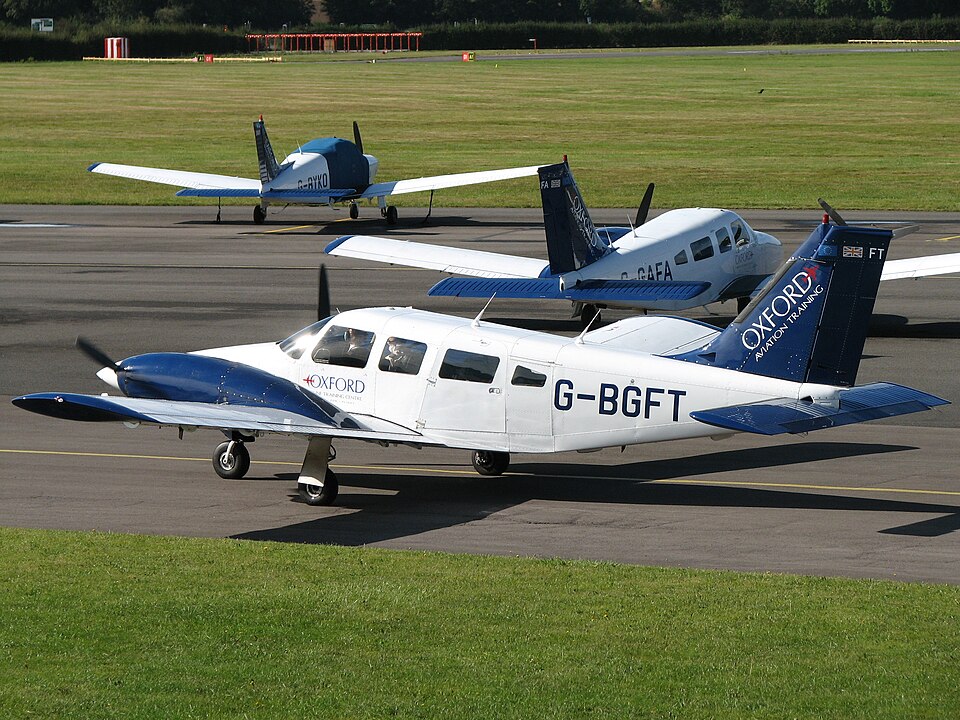
Incident Overview
On 30 May 2001, at approximately 2100 hours UTC, a Piper PA-34-200T twin-engine aircraft, registration G-BGFT, sustained damage during a landing at Coventry Airport, West Midlands. The aircraft was being operated on a training flight with a single student pilot on board. The pilot was on a night solo navigation exercise, intending to conduct a touch-and-go landing at Coventry before returning to Oxford.
Flight Details
The student pilot, aged 21, held a student pilot licence and had accumulated 172 total flying hours, including 32 hours on the type. His recent flying experience included 24 hours in the last 90 days and 9 hours in the last 28 days.
Upon arrival at Coventry, the pilot received radar vectors for an Instrument Landing System (ILS) approach to Runway 23. Weather conditions were fine, with good visibility, few clouds at 3,200 feet, and a surface wind of 270° at 6 knots.
Events Leading to the Incident
The student reported that during the approach, he completed the 'Landing' and 'Finals' checks and confirmed '3 greens' indicating the landing gear was down and locked. However, during the landing flare, the aircraft settled onto the runway surface with the landing gear partially retracted. The propellers struck the ground, causing the engines to stop, and the aircraft came to rest in a wheels-up attitude approximately halfway along the runway.
Aftermath and Damage
The student vacated the aircraft without injury. The underside of the fuselage sustained minor damage, while the propellers experienced substantial damage. No passengers were on board.
Instructor's Report
The student's instructor reported that the student appeared not to have carried out the correct pre-landing and finals checks and only selected the landing gear as the aircraft was settling onto the runway.