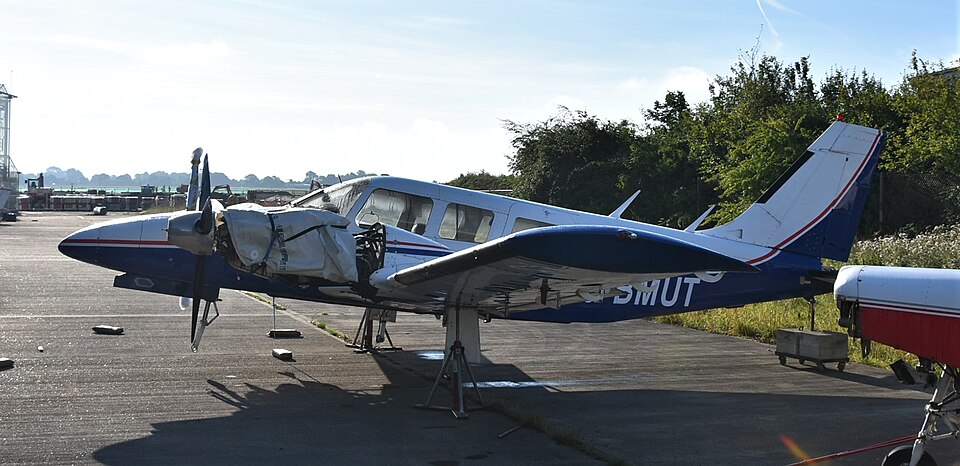
History of the Flight
On 3 February 2001, two pilots flew a Piper PA-34-200T (registration G-BMUT) on a flight test from Newcastle Airport. The aircraft had undergone recent repairs, including replacement of the nose-wheel centering spring assembly and work on cockpit instruments. After refueling, the pilots took off from Runway 25. During the takeoff roll, the airspeed indicator (ASI) stopped rising after indicating 55-60 kt, though the commander estimated speed at 85-90 kt and continued the takeoff. At 200 feet, the landing gear was selected up, but the commander's ASI then showed 40 kt and the co-pilot's ASI was at the low-speed stop.
Informing air traffic control of the problem, the commander performed a low-level circuit. On selecting the landing gear down, the main landing gear (MLG) green lights illuminated, but the nose landing gear (NLG) green light did not, and the red transit light remained on. A low fly-past confirmed the nose gear was not down, though the doors were open. The crew attempted multiple extension methods, including recycling the gear selector, using the emergency extend device, and maneuvering, all unsuccessful.
After about an hour of flight, the crew decided to land on the main wheels only. They made an ILS approach to Runway 25, touched down on the main wheels, and the co-pilot shut down both engines as the nose sank. Both occupants vacated without injury. Damage was limited to the nose wheel doors, forward fuselage, and propeller blade tips.
Aircraft Examination
Examination revealed that the NLG could not extend because the tail of the bolt attaching the forward end of the centering spring assembly to the nose leg was latched over the door actuation aft tube assembly. An incorrect hexagonal bolt had been used and installed upside-down (head uppermost), contrary to the service manual and Service Bulletin No. 893 instructions. Additionally, no retraction test had been performed after the centering spring replacement.
Maintenance Instructions
The Piper Seneca II service manual specifies that the centering spring attachment bolt must be installed with the head down and with a specific washer arrangement. Piper Service Bulletin No. 893 (dated 11 October 1988) requires replacement of any hex-head bolt with a clevis bolt (Piper Part Number 400-910) to ensure clearance, and mandates a retraction test after installation. These steps were not followed.
Pitot/Static System
During subsequent aircraft preparation, the pitot/static system was found to have multiple leaks that prevented ASI indication above 40 kt. Replacement of flexible lines rendered the system serviceable for a ferry flight.