History of Flight
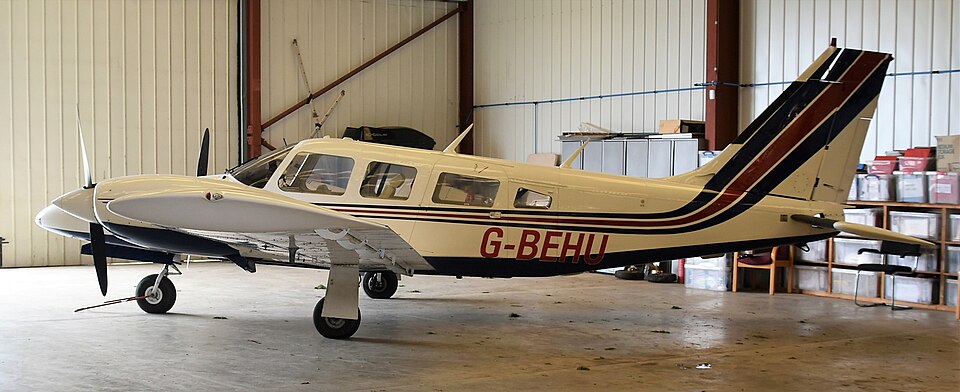
The aircraft, a Piper PA-34-200T Seneca II (registration G-BEHU), was on a private flight from Stapleford to Prestwick with one pilot and four passengers. The approach to Runway 13 was normal. The pilot reported that downwind checks were completed, including confirmation that the three green landing gear down and locked lights were illuminated. Having experienced a prior landing gear issue with this aircraft, he also visually checked the nose landing gear extension using a mirror on the left engine cowl. The landing was described as very smooth. After touchdown, the pilot applied brakes and requested taxi instructions from the tower. As he selected the flaps to UP, a vibration began on the left side, followed by the left propeller striking the runway. The pilot pulled back on the control column and applied right aileron. The right propeller then struck the runway, and a grinding noise was heard from the underside. The aircraft slid on its underside to the left of the runway centerline, rotating 90° before stopping. All occupants exited unhurt; they had been wearing lap strap and diagonal harnesses. No unusual warning lights or sounds were recalled.
Landing Gear System
G-BEHU was equipped with a hydraulically operated, electrically controlled tricycle retractable landing gear with a manual emergency extension system. The nose gear retracts forward, main gears inboard. A hydraulic power pack in the nose, controlled by solenoids and a reversible electric motor, provides pressure for up/down movement. Each gear has UP and DOWN limit switches. The left main gear has a safety (weight-on-wheels) switch that prevents inadvertent retraction when compressed on the ground. Cockpit indications include a red GEAR UNSAFE light, a warning horn, and three green down-and-locked lights. The green lights illuminate when the respective DOWN limit switch is activated. The gear warning horn sounds if the safety switch detects ground compression with the selector not at DOWN, or if any gear is not down and locked with low throttle. Once all three DOWN switches are activated, power to the DOWN solenoid is removed and the gear is held by over-centre springs. The system also automatically attempts to re-lock gears if a DOWN switch indicates unlocked. The gears are not mechanically locked up; hydraulic pressure maintains retraction, with a pressure switch to re-apply pressure if it drops.
Examination of Aircraft
Post-accident inspection revealed scraping damage to the underside of the fuselage, left wing, and left engine cowling. Both propellers were damaged, consistent with low engine power at the time. The left wing underside showed extensive scraping; fuel drains and pitot probe were missing. The right side had less damage. The landing gear selector was found in the DOWN position in the cockpit, but it could not be confirmed if it had been moved after the accident. Several circuit breakers, including those for the landing gear pump and control, were tripped, but it was unknown if they had been deliberately pulled or had tripped before the accident. The emergency gear extension handle was stowed and secured. When the aircraft was lifted, all three gear lock links were found unlocked with no mechanical damage to the mechanisms. The nose gear was fully retracted with doors closed; the main gears were sagging and partially out of their bays. Tyres showed slight rubbing. The landing gear could be manually locked down when the aircraft was lowered. No faults were found with the landing gear or its control system during extensive post-accident testing.