History of the Flight
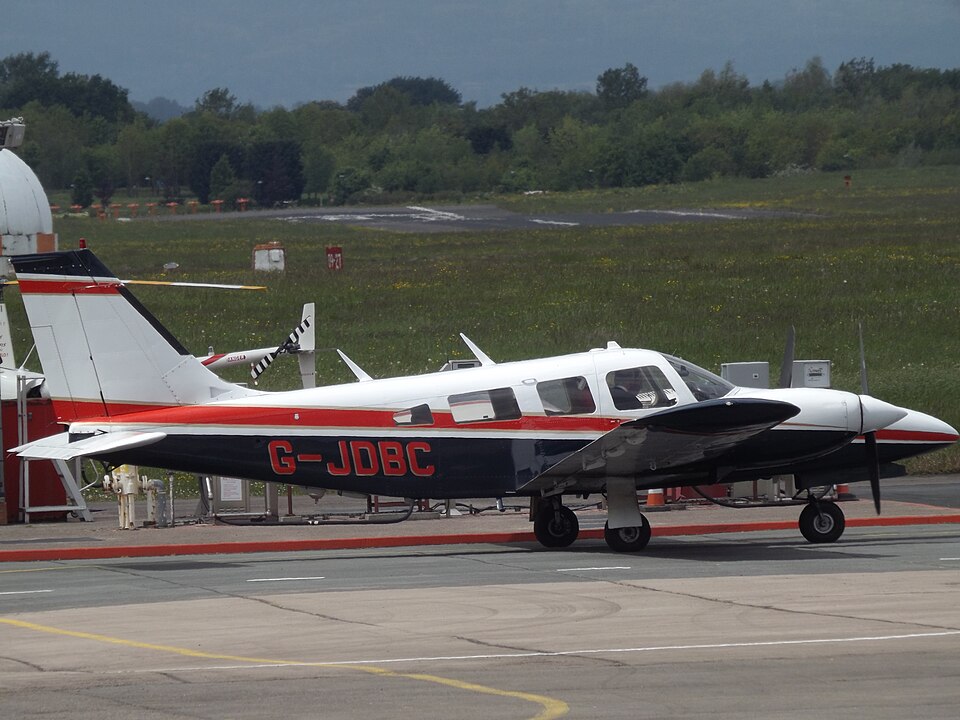
The accident flight involved a Piper PA-34-200T Seneca II, registration G-JDBC, operated by a training organisation. On 30 June 2008, the aircraft departed Manchester Airport for an instrument training detail to Blackpool. After an uneventful landing, the crew conducted asymmetric power training at high altitude, during which the landing gear was cycled six times. The aircraft then proceeded to Tatenhill Airfield for touch-and-go landings on Runway 26. Three touch-and-go landings were performed with practice engine failures, described as smooth with no lateral drift. The next landing was intended to be a full stop for refuelling. However, upon touchdown, the aircraft veered right and threatened to leave the paved surface. The instructor took control and flew the aircraft off the ground. When the landing gear was retracted, the gear unsafe light illuminated. A passenger reported hearing a bang during the earlier touchdown.
Examination of the Aircraft
The aircraft was recovered to a maintenance hangar. Inspection revealed that the left main landing gear forward trunnion fitting had fractured into several pieces. One fragment was later recovered from the Tatenhill runway. Illustrations from the parts catalogue showed the installation details. The fragments were removed and subjected to metallurgical examination.
Metallurgical Examination
Metallurgical analysis of the trunnion fitting showed polished areas on the rear face indicative of fretting—small amplitude relative movement between the fitting and the wing spar surface. Fretting also occurred between the attachment bolts, bolt holes, and washers. Some fracture faces around bolt holes exhibited evidence of very low cycle, high peak stress fatigue cracking, which likely occurred in the later stages of failure after fretting damage. The timeline for the failure process could not be determined, but it probably developed over several landings rather than initiating and failing on the accident day.
Aircraft History and Maintenance
In March 1993, the aircraft manufacturer issued Service Bulletin (SB) No 956 to address potential loosening of trunnion fitting attachment bolts. Part 1 required initial and repetitive inspections; Part 2 provided larger diameter bolts and eliminated the need for repetitive inspections. G-JDBC embodied SB 956 Part 2 on 11 August 2003. Despite this, the maintenance organisation continued to check the torque of the trunnion fitting bolts every 100 flight hours. The most recent check was on 6 June 2008, 24 days before the accident. After the accident, torque checks on the intact right landing gear bolts showed seven bolts at 140 lb.in (within specification of 100-140) and one at 80 lb.in. The torque on the left gear aft fitting could not be measured as it was removed post-accident. In 1995, the aircraft underwent repair involving replacement of the right main landing gear forward and aft trunnion fittings; no record exists of the left gear trunnion fittings being replaced.
Discussion
The metallurgical examination determined that fretting led to low cycle fatigue cracking around the bolt holes, culminating in complete failure of the trunnion fitting—a scenario anticipated in SB 956. The fretting likely resulted from the attachment bolt torques slackening in service. The maintenance organisation had voluntarily continued torque checks every 100 flight hours despite compliance with the service bulletin. The reason for the bolt slackening was not established.