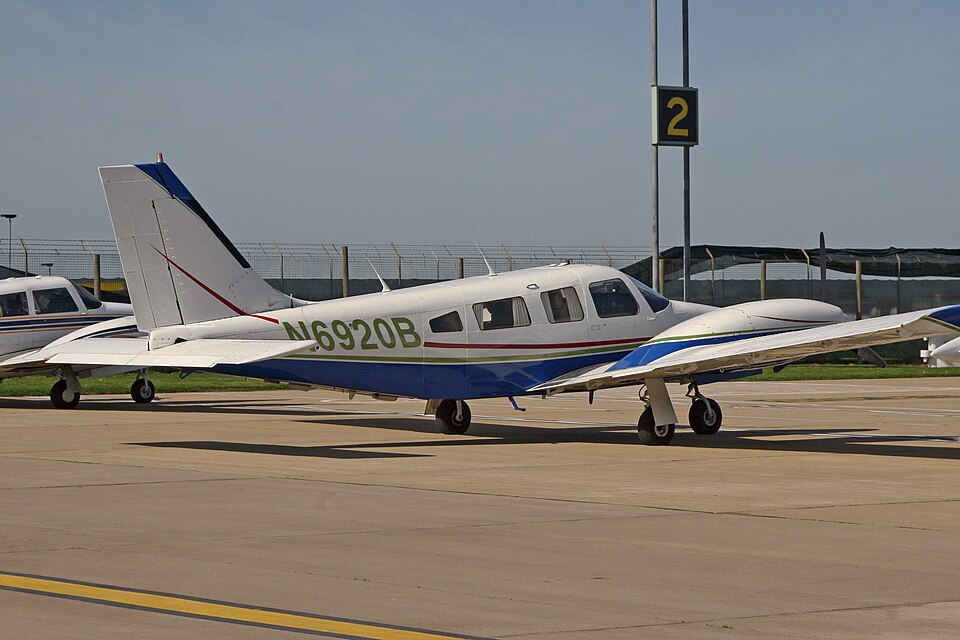
Aircraft and Flight Details
The aircraft involved was a Piper PA-34-220T, registration N6920B, manufactured in 1985. It was powered by two Continental Motors TSIO-360 piston engines. The flight was a training sortie on 5 July 2011, departing from Shipdham Airfield, Norfolk, at 1200 hrs UTC. The commander, aged 53, held a Commercial Pilot's Licence with 1,170 hours total flying experience, including 36 hours on type. The student, seated in the left seat, was employed as a co-pilot on Boeing 737 aircraft and had last flown multi-engine piston aircraft several years prior.
History of the Flight
The instructor briefed the student to conduct circuit flying at Shipdham. Runway 21 was in use under good weather conditions, with wind from 230° at less than 10 kt. After takeoff, the student flew a left-hand circuit culminating in a touch-and-go. On the second landing, the aircraft touched down heavily and bounced; during the second touchdown, the left propeller tips contacted the runway. The instructor called for a go-around, which the student executed. Neither crew member was immediately aware of the damage.
Subsequently, on the next approach, the aircraft touched down in standing crop short of the runway threshold and proceeded through the crop for some distance before becoming airborne again. The instructor again called for a go-around during the ground roll. The instructor then assumed control, flew a circuit, and from the next approach the aircraft again touched down in the crop short of the runway before climbing away. A fourth approach resulted in an uneventful landing.
Damage and Inspection
Post-flight inspection revealed damage to the left propeller blade tips. Later inspection also found damage to the left wing structure. Marks on the runway were consistent with the propeller strike occurring during the second touch-and-go. However, it was not possible to determine whether the structural damage occurred simultaneously or separately, possibly during the ground rolls in the crop or when the aircraft transitioned from the crop onto the paved runway surface across a prominent 'lip'.
Instructor's Observations
The instructor indicated that knowledge of the student's approximately 3,500 hours of experience in turboprop and turbojet airliners may have led her to place too much confidence in his ability. It became apparent after the accident that the student did not understand the relationship between the throttles, propeller controls, and power delivered, having not flown piston-engined aircraft for several years. The approaches were flown with 10° or 20° of flap. The instructor stated she did not pay close attention to indicated airspeed during the approaches; she would normally use an approach speed of 70 to 80 kt. The aircraft flight manual specified that the final approach should be flown with full flap at 90 kt, reducible to 79 kt if lightly loaded. Approaches with less flap would necessitate a higher approach speed. The instructor stated that in future she would be more inclined to take control promptly to correct a student's error.