Summary
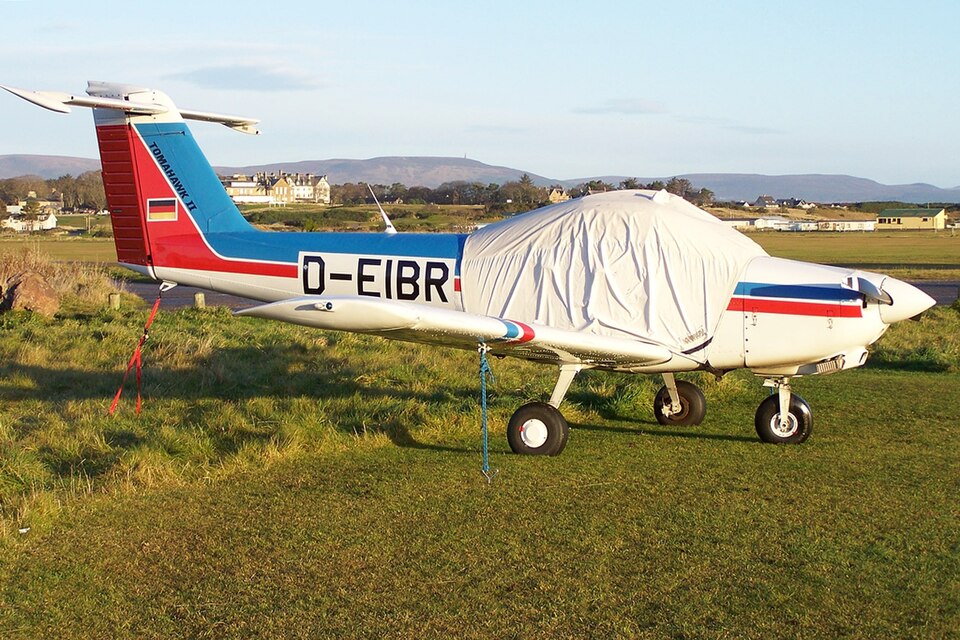
On 3 November 2012, at 1630 UTC, a Piper PA-38-112 Tomahawk (registration D-EIBR, serial number 38-81A0117) sustained substantial damage during a practice forced landing at Dornoch Airfield, Scotland. The aircraft was engaged in a private flight with a single pilot on board. The pilot, who held a Private Pilot's Licence, was uninjured. Damage included the nose landing gear, forward fuselage, cockpit, engine, and propeller.
Aircraft and Pilot Information
The aircraft, manufactured in 1981, was powered by one Lycoming O-235-L2A piston engine. The pilot, aged 51, had accumulated 223 hours of total flying experience, with 75 hours on type. In the previous 90 days, the pilot had flown 7 hours, and in the last 28 days, 4 hours.
History of the Flight
The pilot departed Inverness Airport and flew approximately 20 nm north to Dornoch Airfield with the intention of conducting practice forced landings (PFL). Weather was fine with a light surface wind. Overhead Dornoch, the surface wind appeared negligible, so the pilot commenced a PFL to Runway 28. However, it became apparent that the wind favoured the opposite runway (Runway 10), so he discontinued the PFL and performed a satisfactory PFL to Runway 10 using two stages of flap. The runway at Dornoch was grass, 775 m long.
The pilot then took off again for another PFL, with the windsock still indicating a light easterly wind favouring Runway 10. The pilot described the second approach as being slightly lower than the first, so he did not use flap. The aircraft arrived at the runway at 70 kt, which was allowed to reduce to 65 kt in the flare. The pilot described that the right wing lifted abruptly. He attempted to level the wings and applied full power to go around, but the aircraft pitched violently nose down and yawed to the left. The aircraft had nearly come to a stop on the long grass adjacent to the runway when it pitched slowly forward and turned over.
Aftermath
The pilot, who was uninjured, made the aircraft safe and released his harness without difficulty. However, he was initially unable to open either cabin door. Other persons arrived on scene after a few minutes, but they too were unable to open the doors (each door is secured by a latch, and both doors are also secured by a single latch in the cabin roof). Eventually, the pilot was able to release the roof latch and open a door.