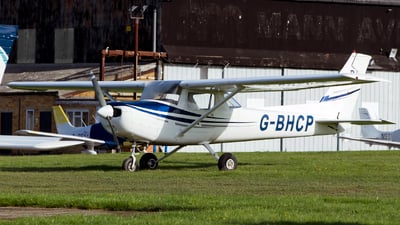
History of the Flight
On 28 January 2006, at approximately 1430 UTC, a Reims Cessna F152, registration G-BHCP, was conducting a training flight near Meden Vale, Nottinghamshire. About 20 minutes into the flight, the engine rpm began to decrease and the engine ran unevenly. The instructor applied full power to initiate a climb. Ten seconds later, the rpm reduced further and the engine became erratic. The instructor applied carburettor heat and noted severe vibration. He trimmed for best glide speed, transmitted a 'PAN' call on the departure airfield frequency, and began searching for a suitable landing field. The propeller and vibration suddenly stopped. The instructor performed forced landing checks, including briefing the student and transmitting a 'mayday' call. The aircraft was successfully landed in a field about half a mile southeast of Meden Vale, sustaining damage to the nose landing gear and distortion of the lower engine cowling. Both the instructor and student evacuated safely and were not injured.
Engineering Examination
Inspection by the maintenance organisation revealed that the No 4 cylinder had completely separated from the engine in the area between the cooling fins and the cylinder-to-crankcase mounting flange. The cylinder pieces were sent to the AAIB for detailed metallurgical examination. The examination showed that corrosion had occurred on the outer surface of the cylinder, reducing wall thickness and producing corrosion pits over time. These pits acted as stress raisers, which, combined with the reduced wall thickness, allowed fatigue initiation and propagation. A fatigue crack initiated and propagated around approximately 36% of the cylinder’s circumference before final overload failure.
Aircraft and Engine History
The aircraft had been on the UK register since manufacture and was owned by several individuals and flight training organisations. The previous owner ceased operations in April 1998 and the aircraft was stored outdoors until purchased in early 2005. The engine was overhauled in 1997 with a new log book starting at zero hours, but no overhaul documentation was provided to the owner. At the time of the accident, the engine had accumulated 162 hours since overhaul. In August 2005, all cylinders were removed and honed, and new piston rings fitted. In December 2005, a split cylinder base seal on No 4 cylinder was replaced.
Similar Occurrences
The CAA Mandatory Occurrence Reporting database and AAIB accident databases were searched for similar failures of Lycoming O-235 series engine cylinders. A total of 24 occurrences were found, including this accident. Seven of these were investigated by accident investigation organisations (six by the AAIB and one by the German BFU). The remaining 17 either resulted in safe landings or were discovered during maintenance. The French BEA also reported 34 similar events in France.
Safety Recommendations
This AAIB report includes seven Safety Recommendations (not detailed here).