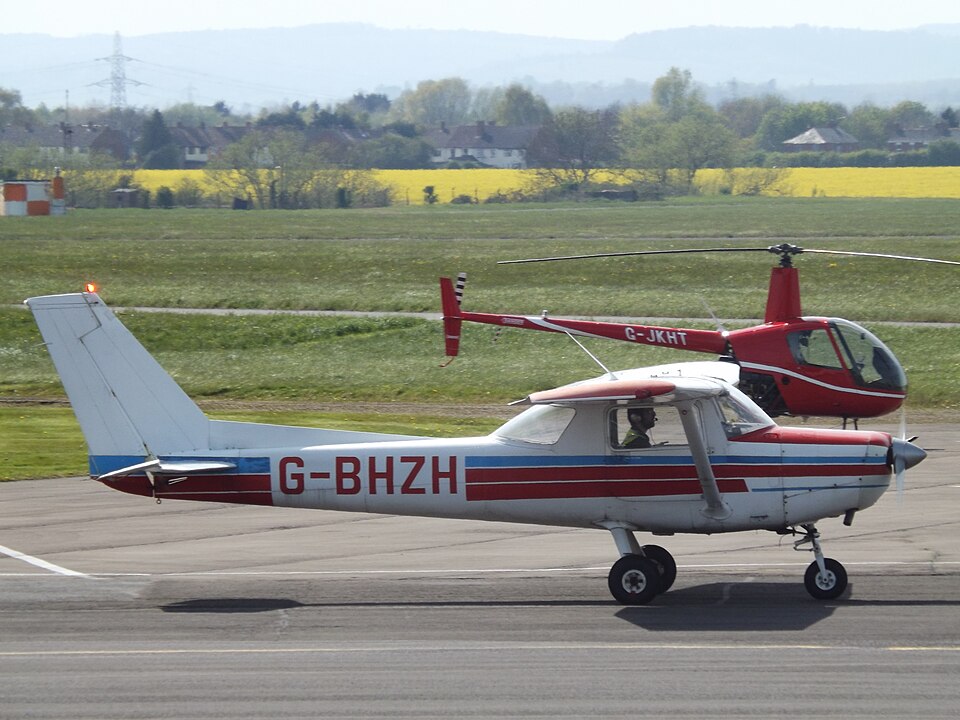
Accident Details
On 16 February 2005 at 1635 hours UTC, a Reims Cessna F152, registration G-BHZH, was involved in an accident at Exeter Airport, Devon. The aircraft was on a training flight with a single occupant, the student pilot, who held a student pilot licence and had 19 hours of total flying experience, all on type. The most recent 90 days included 10 hours, with 3 hours in the last 28 days. The aircraft, manufactured in 1980, was powered by one Lycoming O-235-L2C piston engine. The pilot reported no injuries, and damage was limited to the left wing and nose wheel.
Sequence of Events
The student pilot had completed three successful circuits with an instructor and was performing a solo circuit with a flapless 'touch and go' landing on Runway 08. The landing was smooth and on the centreline. Upon application of full power for takeoff, the aircraft suddenly yawed to the left. The pilot applied right rudder to correct, which caused a violent change of direction to the right. He then attempted to correct with left rudder. Realising control was lost, he fully closed the throttle. The aircraft departed the left side of the runway. The pilot did not apply the brakes initially to avoid upsetting the aircraft's balance. When the aircraft did not slow as expected on the grass, he applied gentle braking. The aircraft then bounced, causing the left wing to drop and the wingtip to strike the ground. It continued forward, crossing an area of hard standing before coming to rest on the grass beyond. The nose wheel was damaged when it struck a ridge at the edge of the hard standing.
Post-Accident Observations
Immediately after the accident, a second flying instructor took the student for a flight in another aircraft. The instructor noted that while the student was very competent, on two occasions while taxiing, he applied left rudder when intending to turn right. The student accepted that he may have reacted incorrectly during the touch and go by applying left rudder as he applied full power. Given the aircraft's natural tendency to yaw left when power is applied, inadvertently applying left rudder at a relatively high airspeed during a touch and go would produce a sudden yaw to the left. Excessively large corrective rudder inputs at such an airspeed can lead to over-controlling and a loss of directional control.