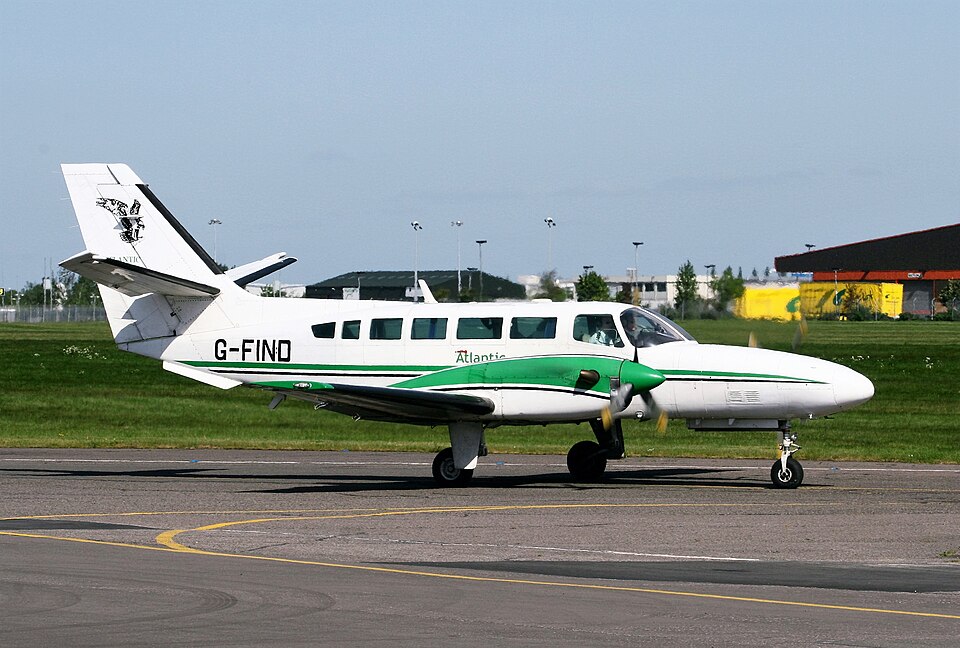
Incident Overview
On 6 September 2007 at 1237 UTC, a Reims Cessna F406 Caravan II (registration G-FIND) was conducting a crew training flight at Coventry. The aircraft, equipped with two Pratt & Whitney Canada PT6A-112 turboprop engines and built in 1989, had two crew members on board (no passengers). The pilot flying (PF) was in the right seat, while the aircraft commander (check pilot) occupied the left seat. No injuries were reported, and the aircraft sustained no damage.
History of the Flight
The flight involved asymmetric training, with the left engine at zero thrust simulating a feathered condition and the right engine at 600-700 lbs torque, maintaining 140 KIAS. While at 1,000 ft AGL on a simulated asymmetric circuit to Runway 05, the PF flew a left-hand orbit for spacing. Shortly after rolling out of the orbit, the PF noticed an uncommanded roll to the right. Assuming turbulence, he corrected with left aileron but found excessive force needed and limited control wheel deflection (estimated 20° left). He restored the simulated failed engine and handed control to the commander, who confirmed the aileron restriction (20°-30° maximum deflection). The PF declared a Mayday as the aircraft began a slow right turn toward the final approach track. The commander visually checked for asymmetric flaps or abnormal panels but found none.
The PF allowed the right turn to continue, reducing opposite roll force, and G-FIND entered a descending right turn toward final approach. The shortened route placed it behind two slower light training aircraft. The PF required extreme physical force to control the aircraft; during the turn onto finals, the rudder seemed jammed neutral, and later pitch forces became excessive. The PF chose to land with approach flap without changing configuration. At approximately 300 ft AGL, the crew felt a lurch and regained partial control in pitch and roll, though rudder pedals remained restricted. The PF noticed the pitch trim had run away to full nose-up trim. The aircraft landed successfully on Runway 05 about 90 seconds after the first control issue. During rollout, the commander found rudder pedal movement limited to about one inch in either direction. The crew taxied to parking using differential power and brakes. After shutdown, they discovered the electric trim switch assembly on the PF’s control yoke had broken loose.
Commander's and PF's Comments
The commander recalled that during the pre-flight control check, the pitch trim wheel had moved; he assumed the PF had moved it accidentally or deliberately. He did not check the autopilot mode annunciations during the incident. The PF stated he did not press the autopilot disengage switch (as he did not believe the autopilot was engaged) and could not recall knocking the autopilot engage switch. He intended for the commander to check mode annunciations over the artificial horizon.
Aircraft Examination
Examination the following morning found no obstructions or foreign objects in the under-floor control runs. With the aircraft jacked and gear retracted, control and autopilot functional checks revealed no jamming or restriction. However, upon selecting the yaw damper, rudder-free travel became very limited, and no visual indication of yaw-damp engagement was evident; the yaw damp selector button bulb was non-functional, and the autopilot mode indicator operated in dim mode regardless of ambient light. With autopilot selected, the aileron servo responded to a position signal from the unpowered gyro system and drove roll control to full travel, requiring high forces to resist. Engine runs and ground taxi with various autopilot modes showed no unexpected inputs. It was noted that the left knee of the pilot in the right seat was very close to the autopilot activation switch, especially in asymmetric flight with left engine idle. Subsequently, power to pitch/roll servos, yaw damper, and pitch trim actuator was disconnected, and the aircraft was test-flown manually, including reproduction of asymmetric power conditions—no control problems occurred. The aircraft returned to service with electrical actuators disconnected, operating in purely manual mode, with no further issues reported.
Component Examination
The autopilot control unit (designed over 20 years ago and no longer in production) could not be fully evaluated due to limited technical support. Examinations of wiring on G-FIND (unlike a previous incident on G-SFPB) found no faults in the relevant cable looms.
Previous Incidents
Mandatory Occurrence Reports on other Reims Cessna 406 aircraft noted unresolved flying control issues, including an uncommanded autopilot engagement on G-SFPB that could not be overcome by the right control column switch. After repair of chafed wiring, no further problems occurred.