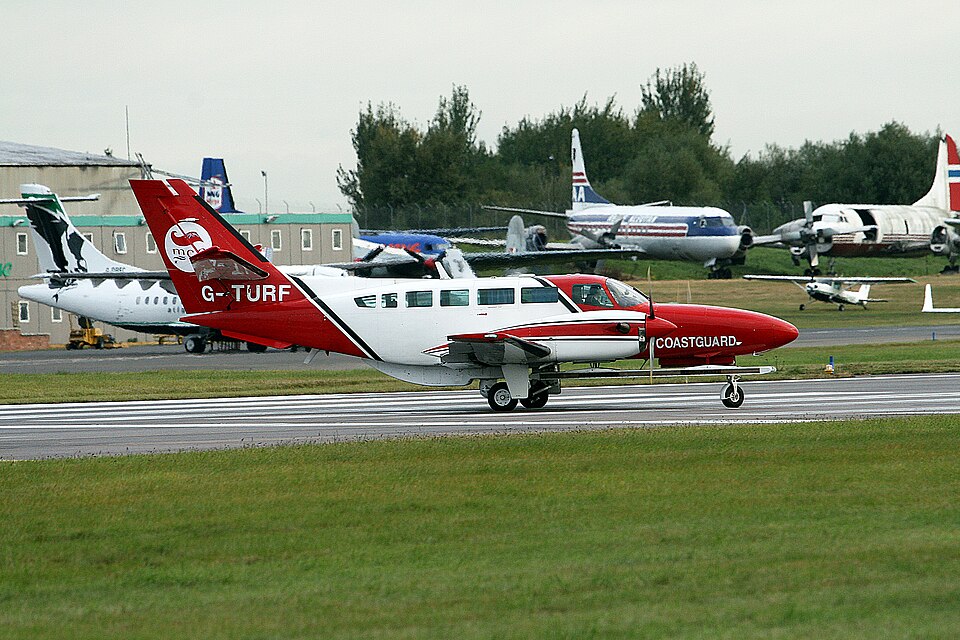
Incident Overview
On 25 July 2000, a Reims Cessna F406 (registration G-TURF) operating a cargo flight from Kirkwall experienced a wingtip strike during landing at Sumburgh Airport, Shetland Isles. The aircraft, powered by two Pratt & Whitney PT6A-112 turboprop engines, was on a public transport cargo flight with a sole pilot on board. The pilot was uninjured.
Approach and Landing
The aircraft was cleared for the LOC DME approach to Runway 09 at Sumburgh. The localiser course is offset by 3°, giving an approach track of 086°, while the runway centreline is 089°. The minimum descent altitude (MDA) for this approach is 320 feet, and the missed approach point is 0.5 nm from the displaced threshold of Runway 09.
At 0734 UTC, the ATIS was broadcasting 'Information Juliet' with the following conditions: surface wind 050°/19 kt, visibility 2,300 m, broken cloud base 300 feet, temperature/dew point 11°/11°C, and QNH 1009 mb.
The pilot reported intermittent contact with the surface at 900 feet amsl. At MDA, he had continuous contact and flew level for a short distance before seeing the threshold. The aircraft appeared slightly right of the centreline. The pilot decided to land, closed the throttles, set propellers to maximum RPM, selected full flap, lowered the nose, and banked left to regain the centreline.
Wingtip Strike
As the aircraft regained the centreline, the pilot applied right bank to maintain it. The aircraft rolled rapidly to the right, and despite full left aileron input, the right wingtip struck the runway surface. After the pilot was satisfied all three wheels were on the ground, he selected maximum reverse thrust but could not stop the aircraft before it left the runway to the right. It came to a halt on the grass, having caused damage to one runway edge light.
Damage and Aftermath
Inspection revealed the outer 1.5 feet of the right wingtip, outboard of the aileron, was bent upwards at an angle of about 45°. The pilot taxied the aircraft back onto the runway and to a stand as directed by ATC. The aircraft sustained damage to the right wingtip only.
Pilot Experience
The commander held an Airline Transport Pilot's Licence, aged 25, with 1,928 total flying hours (526 on type), including 188 hours in the last 90 days and 72 hours in the last 28 days.