History of the Flight
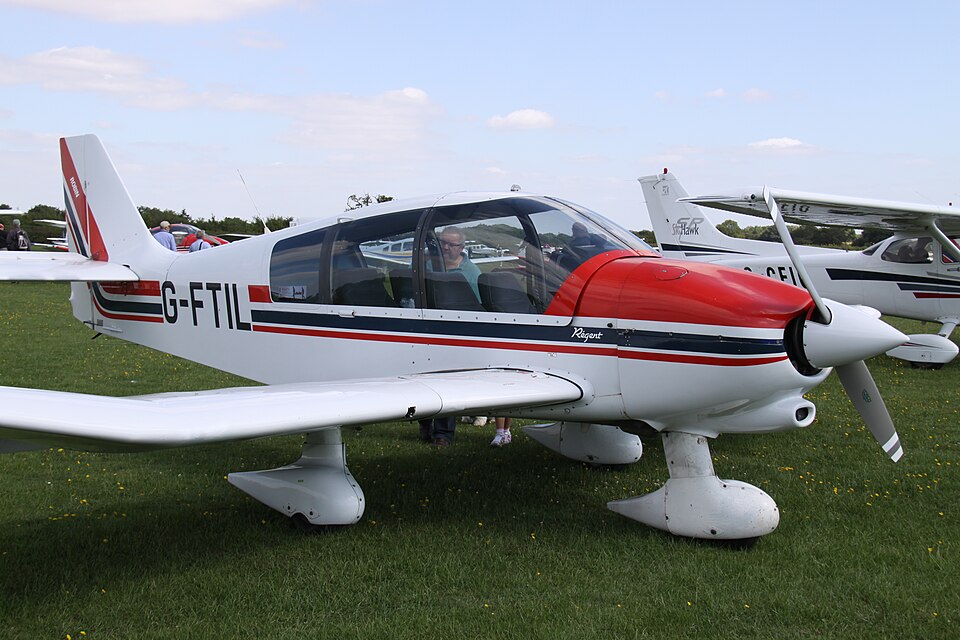
The aircraft, a Robin DR400/180 Regent registered G-FTIL, was being flown to Little Staughton Airfield for pre-arranged scheduled maintenance. The weather at the airfield was CAVOK with a surface wind from 250° at 10 kt. After a normal landing on Runway 25, the aircraft veered violently to the left and the nose landing gear (NLG) collapsed. The propeller contacted the ground, causing the engine to stop. The aircraft slid approximately 20 metres before coming to rest 5 metres from the edge of the runway. The sole pilot and single passenger were not injured.
Engineering Examination
A detailed metallurgical examination of the nose landing gear confirmed a fatigue failure in the narrow strap section of the upper support plate. This failure resulted from normal in-service loads and a circumferential separation of the fillet weld between the upper support plate and the outer cylinder. The weld was of very poor quality: its cross-sectional dimensions were inadequate around the entire circumference for the type of joint, and there was gross gas porosity in the area of separation. Further examination revealed gross gas porosity throughout the complete weld circumference. The weld had been made using the Gas Tungsten Arc Welding (TIG) method and was the original manufacturing weld.
Nose Landing Gear History
In February 1993, the aircraft had a landing accident during which the nose landing gear was damaged. The repair organisation replaced the NLG with a new item supplied by the manufacturer's UK agent. This replacement NLG, manufactured in 1978, had completed approximately 2,700 landings prior to its failure.
Similar Incident
A previous accident involving a DR400 aircraft, G-BJUD, in November 2001 (reported in AAIB Bulletin 8/2002) also involved a nose landing gear collapse. In that case, fatigue cracking had occurred in the narrow strap sections of the upper support plate, leading to tensile overload failure of the weld. The upper support plate had been welded both top and bottom to the oleo outer cylinder, with the top weld being unapproved and added after manufacture. The bottom weld, made during original manufacture, exhibited poor penetration and excessive gas porosity.
Welding Standards
At the time of manufacture of the NLGs for G-FTIL and G-BJUD, the aircraft manufacturer reportedly used a military standard for welding called 'Norme Air 0191', with individual welders qualified under section 'L'institut de soudure' of this standard. There is no procedure within French civil aviation regulations that stipulates this military standard. European standards for welding practices and procedures in aerospace were under development, with existing Euro Norms providing general guidelines.
Safety Recommendations
The investigation led to several safety recommendations:
- Recommendation 2004-86: To the manufacturer, Apex Aviation, that Service Bulletin 101 be re-issued to include inspection of the Upper Support Plate in the same areas as those specified for the Lower Support Plate.
- Recommendation 2004-87: To the Director Generale de L'Aviation Civile (DGAC), France, as lead agency for the European Air Safety Agency (EASA), that Airworthiness Directive No 83-206(A) be re-issued to include inspection of the Upper Support Plate.
- Recommendation 2004-88: To the DGAC that the standard of welding made by Apex Aviation be assessed to ensure compliance with European and French requirements for aviation component manufacture.