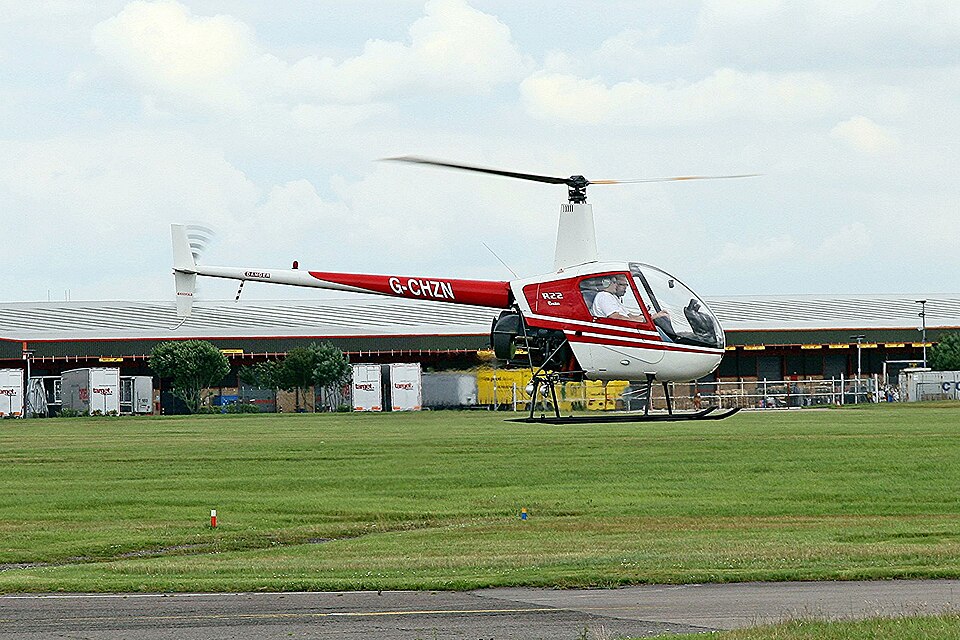
On January 6, 2012, a Robinson R22 Beta (registration G-CHZN) was involved in an aviation accident near Ely, Cambridgeshire, GB. Investigators recorded the probable cause as: Main rotor divergence resulting in mast bumping, the rotor blades striking the airframe and rotor blade separation. This summary draws on records from the UK Air Accidents Investigation Branch (AAIB).
A Robinson R22 Beta helicopter, G-CHZN, crashed near Ely, Cambridgeshire, on 6 January 2012. The pilot was fatally injured when the aircraft suffered main rotor divergence and mast bumping.
Accident Overview and Aircraft Details On 6 January 2012, a Robinson R22 Beta helicopter, registration G-CHZN, was destroyed in an accident near Ely, Cambridgeshire. The aircraft, manufactured in 1988 with serial number 884, was powered by a single Lycoming O-320-B2C piston engine. The flight was a private operation from Manston Airport to Fenland Airfield, with one crew member on board and no passengers. The pilot sustained fatal injuries in the crash. ## Pilot Background and Experience The commander held a Private Pilot’s Licence (Helicopters), which was issued on 14 December 2011. He was an experienced fixed-wing pilot with 4,960 hours of flying experience, holding an ATPL(A) and serving as a Flight Instructor and examiner. His helicopter experience totaled 59 hours, all of which were on the Robinson R22 type. In the 90 days prior to the accident, he had logged 18 hours, and in the 28 days prior, 12 hours. The pilot had planned to build his helicopter hours to gain a Commercial Pilot’s Licence (Helicopters) and Flight Instructor (Helicopters) qualifications. ## Flight History and Final Moments G-CHZN departed Manston Airport at 0958 hrs UTC. The helicopter climbed to 2,000 feet above mean sea level (amsl) and crossed the Thames estuary. It descended to approximately 1,500 feet amsl and remained between 1,200 and 1,500 feet amsl for the remainder of the flight. At 1105 hrs, the helicopter was near Haverhill, 12 nm south-east of Cambridge Airport. The pilot turned right onto a track of approximately 345°T towards Newmarket. At 1111 hrs, he reported being 5 miles from the runway and routing directly towards Cambridge Airport. At 1114 hrs, the controller informed the pilot he could not be cleared through the overhead due to traffic. The pilot acknowledged and turned towards Fenland. At 1118 hrs, the pilot reported an altitude of 1,400 feet with QNH 1026, which was the last radio transmission. At 1121 hrs, the helicopter entered the western stub of the Mildenhall Military Aerodrome Traffic Zone (MATZ) at 1,350 feet amsl. At 1123 hrs, approximately 3 nm south of Ely, the pilot turned left towards Fenland. ## Witness Accounts and Recorded Data Witnesses near the accident site observed the helicopter at approximately 1,500 feet above ground level (agl) on a heading of 300°(M). They reported the helicopter suddenly began to roll left, with one witness noting it pitched up before rolling. Both witnesses heard a loud “pop” and saw objects separate from the helicopter. The aircraft then fell inverted to the ground. A third witness heard a “backfire” or “pop” and saw a puff of smoke and sparks, but did not observe the roll or rotor blade detachment. Radar and GPS data indicated the helicopter was on a track of approximately 330° when it disappeared from radar at 1125:48 hrs. The final GPS point at 1125:20 hrs recorded the helicopter at 1,504 feet amsl (approximately 1,480 feet agl) on a track of 333°. The transponder was transmitting Mode A information only, as the Mode C function was inoperative, so no altitude record was available from radar recordings. The final radar positions were between 15 m and 220 m from the fuselage impact point. ## Cause and Safety Recommendations The accident was caused by main rotor divergence resulting in mast bumping, with the rotor blades striking the airframe and separating. The report includes Safety Recommendations to the European Union Aviation Safety Agency (EASA) and the Federal Aviation Administration (FAA) regarding certification requirements for future light helicopters to reduce the risk of “loss of main rotor control” accidents. ## Environmental and Operational Factors Analysis of radar records indicated it was highly unlikely the helicopter encountered wake turbulence or that the pilot maneuvered suddenly to avoid a conflicting aircraft. The possibility of the pilot maneuvering to avoid birds could not be discounted. Mountain waves were visible over the southern Pennines, but it was unlikely moderate turbulence extended as far south-east as Cambridgeshire. The pilot did not report any problems with the helicopter’s controls or engine during radio transmissions. Mobile phone records showed the pilot neither made nor received calls or messages during the flight.
Probable cause
Main rotor divergence resulting in mast bumping, the rotor blades striking the airframe and rotor blade separation.