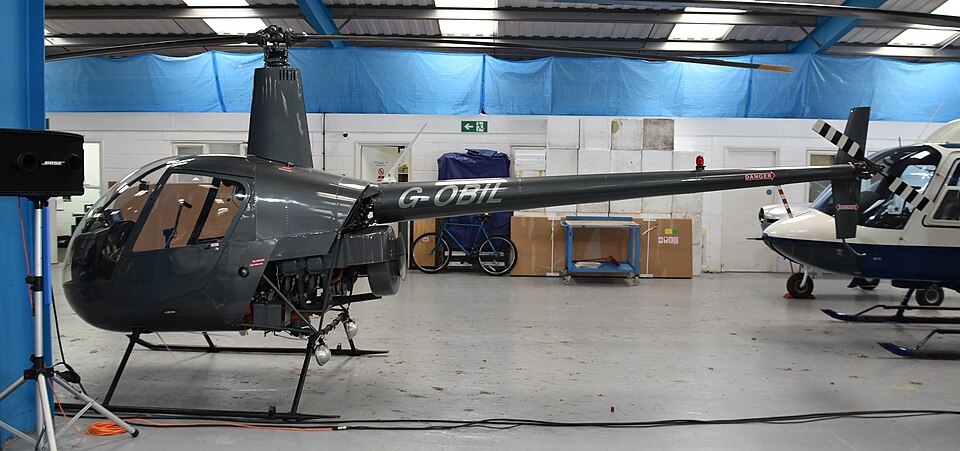
History of the Flight
On 18 July 2007, a student pilot was conducting after-start checks in a Robinson R22 Beta (registration G-OBIL) on the concrete apron at Peterborough (Conington) Airfield, Cambridgeshire. The aircraft was facing south, and the wind was reported as 210 degrees at 12 knots. After completing initial interior and engine-start checks, including switching the rotor rpm governor ON when engine rpm was below 80%, the student increased the rotor rpm to 104%. At that point, the aircraft began to rotate anti-clockwise. The pilot immediately closed the throttle, causing the rpm to initially drop before quickly rising back to 104% as the governor reopened the throttle. The aircraft continued rotating for five or six revolutions across the ground until the tail rotor struck the grass and broke, bringing the rotation to a stop. Throughout the event, the collective remained in the fully lowered position. The pilot then shut down the engine and vacated the helicopter normally.
Aircraft Information
The Robinson R22 Beta, manufactured in 1988, is powered by one Lycoming O-320-B2C piston engine. The helicopter sustained severe damage to the tail rotor and main frame distortion. The student pilot, aged 39, held a Student Pilot licence with a total flying experience of 68 hours, of which 32 were on the R22 type. His recent flying included 35 hours in the last 90 days and 33 hours in the last 28 days.
Rotor RPM Governor
The rotor rpm governor is designed to maintain rotor rpm between 97% and 104% by mechanically opening and closing the throttle. It is active only when engine rpm exceeds 80%. If the pilot closes the throttle while the governor is active (overriding it) and then releases or relaxes his hold on the throttle, the governor will reopen the throttle to restore rotor rpm to 104%.
Pilot's Comments
The pilot stated that he inadvertently applied left rudder pedal as he opened the throttle, creating an anti-clockwise turning force on the aircraft. As the aircraft began to rotate, he did not consider applying opposite pedal because he was concentrating on keeping the aircraft upright and closing the throttle.